Marquesitas: the origin of the street dessert you'll love
🚀 Key Takeaways
- Key concept : A Yucatecan street crepe combining dulce and queso (cheese).
- Practical tip : Try a marquesita con queso de bola and cajeta at a night market in Mérida or Playa del Carmen.
- Did you know : The sweet-salty contrast comes from Edam-type cheese (queso de bola) widely used in the region.
Crunchy, warm and slightly salty: the first bite tells you why marquesitas became an obsession.
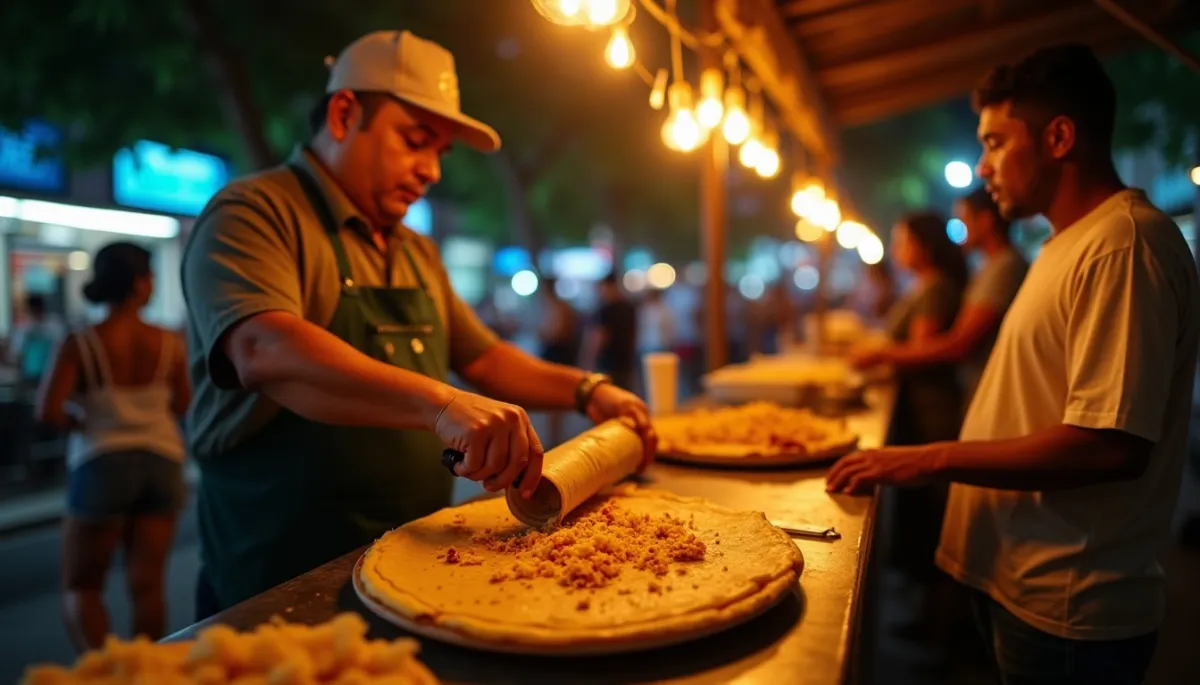
Imagine a humid evening in Mérida, sometime after sunset, when the plazas fill with families and music. Under strings of bulbs, a small iron presses a thin batter into a paper-thin disk. In seconds, the vendor folds it around a generous ribbon of shredded queso de bola and drizzles cajeta or chocolate, rolling the whole into a cigarette-shaped delight. Children run by with sugar on their lips, tourists take the first cautious bite, then grin. That moment captures why marquesitas belong to the street life of the Yucatán.
Goût et diffusion
Marquesitas are, first and foremost, a taste phenomenon. Their base is a batter of flour, egg, milk and a touch of sugar, cooked on a hot iron until it is crisp like a tuile. The traditional filling is shredded queso de bola (a firm, slightly salty Edam-style cheese), combined with cajeta (a goat‑milk caramel), condensed milk, fruit jams or chocolate. The sweet and salty contrast is immediate and addictive.
Historically associated with fairs and night markets, marquesitas gained visibility in Mérida during the mid-20th century. Vendors set up carts near parks such as Parque Santa Lucía and Paseo de Montejo, and the treat became synonymous with evening promenades. Over the last two decades, their popularity spread to Campeche, Cancún, Playa del Carmen and Tulum, driven by tourism and social media images of perfectly rolled, dripping marquesitas.
Today you find marquesitas from roadside stands to boutique food trucks, and even on menus in contemporary Yucatecan restaurants. Prices range widely depending on location and fillings, typically from around 30 to 120 MXN in 2026, which keeps them accessible as a casual snack or dessert.
Racines et raisons
Linguistically and culturally, the origin of the name remains a little mysterious. Some attribute it to an evocation of elegance (marquesita as a diminutive of marquesa), suggesting a playful irony: a street treat with a noble-sounding name. Whatever the exact etymology, the recipe itself is a product of local trade and palate.
Queso de bola came to the Yucatán through Dutch trade routes and became popular locally, especially during the 19th and 20th centuries. Its firm texture and mild saltiness made it perfect for pairing with sweet ingredients. The marquesita, by assembling thin crisp pastry and salty cheese, reflects a long Mexican tradition of balancing textures and flavors, like the pairing of fruit and chili.
Practically, the marquesita is ideal for street vending: quick to cook, easy to eat while walking, and versatile in fillings. Vendors adapted the basic formula over decades, adding Nutella, Oreo crumbs, fruit, and even savory options. The result is a culinary chameleon that appeals to families, late-night crowds and food-tourists alike.
Tradition et modernité
Cependant, the story of marquesitas illustrates tensions between tradition and modern trends. While many vendors preserve the classic technique and the iconic queso de bola, a new wave of gourmet marquesitas has emerged. Chefs and food entrepreneurs in Mérida and Playa del Carmen offer versions with artisanal fillings, local honey, or premium chocolate, presented in stylish wrappers for Instagram.
At the same time, street vending faces regulation and economic pressures. Municipal ordinances in various cities have periodically restricted informal stalls for sanitation or urban planning reasons, pushing some vendors to formalize or relocate. For travelers, this means the best marquesita experience can require a bit of local knowledge: ask residents where the long queue forms, or look for vendors with consistent crowds.
There are also sustainability questions. Traditional marquesitas are wrapped in paper, but plastic forks, sachets and single-use packaging often accompany modern service. A small change you can support is asking vendors to use paper-only wrappers or bringing your own napkins, a tiny gesture that helps keep Riviera Maya's markets charming and cleaner.
Tips for first-timers: try the classic with queso de bola and cajeta, order it freshly made, and enjoy it while warm. In Mérida head to evening stalls around Parque Santa Lucía; in Playa del Carmen look near 5th Avenue's food spots; in Cancún check Mercado 28. If you enjoy contrasts, ask for additional toppings like banana or Nutella.
Marquesitas are more than a sweet street snack; they are a culinary postcard from the Yucatán, portable and democratic, carrying history in a roll. Taste one and you take home a little of the region's night air, its markets and its knack for surprising flavor combinations.
Thanks for reading, and don't forget, Enjoy Life Moments!