Night dive in the reefs of Cozumel: a fluorescent universe
🚀 Key Takeaways
- Key concept : Fluorescence is visible under blue/UV light and reveals pigments in many reef organisms.
- Practical tip : Bring a blue excitation torch and a yellow camera filter, dive with a certified night operator in San Miguel.
- Did you know : Cozumel belongs to the Mesoamerican Barrier Reef, about 1,000 km long, the second largest reef system in the world.
It feels like entering a secret garden.
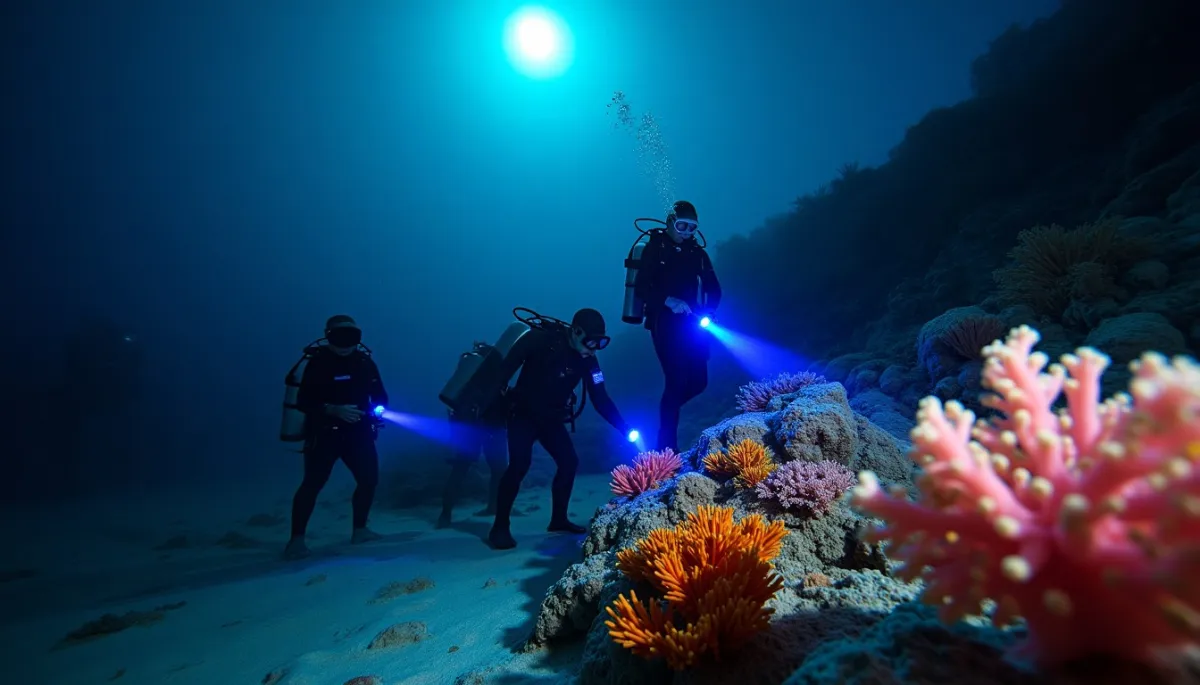
At 20:30, the dive boat slips away from Playa San Miguel, lights dimmed, and the first blue beams cut through velvet-black water. Palancar's ledges melt into silhouettes, while tiny points of neon start to blink on: polyps retracting then glowing, a curled nudibranch flashing magenta, an orange cup coral pulsing like a tiny lantern. Around you, helmets of divers reflect tiny constellations of plankton and the distant profile of eagle rays passing in the moonbow.
Blue fireworks
Night diving in Cozumel is not merely the daytime reef with less light. The reef becomes chemically and visually different. Under blue or UV excitation, proteins and pigments in corals, sponges, worms and even some fish absorb light and re-emit it at longer, often vivid wavelengths. The result is a palette that the human eye rarely sees by daylight.
This phenomenon is rooted in biology. Fluorescent proteins, long studied since the discovery of GFP (green fluorescent protein) in the jellyfish Aequorea victoria, have been identified in many scleractinian corals. Research in the early 2000s (for example Salih and colleagues) mapped fluorescence across reef organisms, opening a new window for underwater imaging and conservation diagnostics.
On Cozumel, famous dive sites like Palancar, Santa Rosa Wall and Colombia Reef offer clear water and topography that amplify the effect. The steep walls and overhangs collect sessile lifeforms that produce intense fluorescence, and the island's protection as Parque Nacional Arrecifes de Cozumel (established in 1996) helps keep visibility high and macro-life plentiful.
Why it glows
Why do organisms fluoresce? The short answer is multiple reasons. Fluorescent pigments can protect against excess sunlight, act as sunscreens, assist in photoprotection of symbiotic algae, or serve as signaling for mating and camouflage. Scientists still debate the primary functions, but practical applications emerged quickly: fluorescence can be an indicator of coral stress or health.
For photographers and naturalists, fluorescence is a way to see hidden biodiversity. Creatures that are cryptic by day reveal their outlines and colors at night. Night-active species, like lobsters and some shrimps, may display fluorescent bands. Nudibranchs and certain polychaete worms show neon edges that are nearly invisible in white light.
Workshops and expeditions led by underwater photographers such as Alex Mustard and local experts have popularized fluorescence photography since the 2010s. They recommend a blue excitation source (around 450 nm) combined with a yellow long-pass filter on the camera to capture emitted light without the excitation glare.
Rules and tips
Practical safety first. Night dives require proper certification or experience, a reliable dive light for navigation, a backup light, clear communication signals, and strict buddy procedures. Many Cozumel operators will ask divers to have at least a basic night dive experience before joining reef night dives.
For the best fluorescent images, use a dedicated blue torch and a camera filter. Keep distance to avoid disturbing the animals. Never touch corals or chase creatures; many fluorescent animals are fragile or nocturnal in order to feed and avoid predators. The marine park enforces no-touch rules and collects fees that aid conservation and surveillance.
Timing matters. The prime hours are the first two hours after sunset when many species are emerging, and plankton is still settling. Visibility in Cozumel frequently exceeds 20 meters, but bring your own light and trust local guides who know where grottos, ledges and overhangs concentrate fluorescent life.
Thanks for reading, and don't forget, Enjoy Life Moments!