The Maya obsession with jade: the stone more precious than gold
🚀 Key Takeaways
- Key concept : Jadeite from the Motagua Valley was rarer and more symbolic than gold to the Maya.
- Practical tip : See jade collections at Museo Maya de Cancún or Museo Popol Vuh in Guatemala; buy certified pieces only.
- Did you know : Pakal the Great (Palenque, d. 683 CE) was entombed with thousands of jade beads and a jade mask.
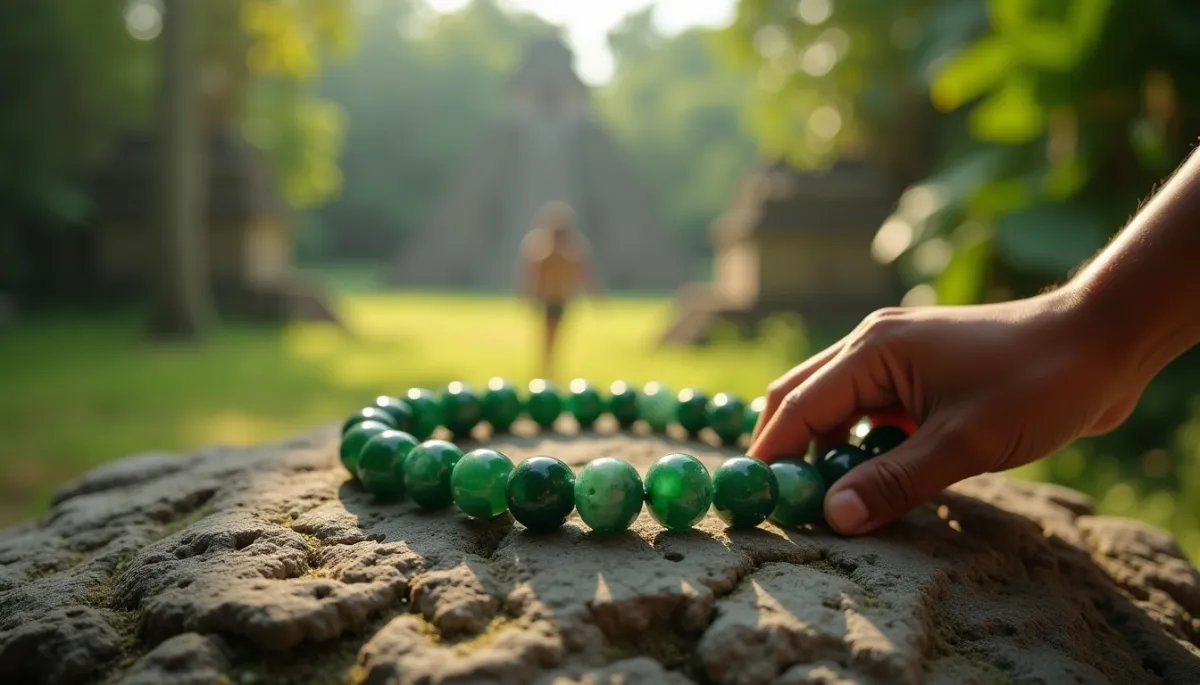
Close your eyes and imagine the weight of a polished green bead between two fingers.
On a humid morning at Palenque, sunlight slants through dense leaves and hits a vitrified shard of jade displayed behind glass. A guide whispers about a king whose face was covered with green stones in death, and for a moment the patina on that tiny piece connects you to a ritual performed thirteen centuries ago.
Green as power
Jade was not a decorative afterthought for the Maya. From the Preclassic era (c. 1000 BCE) through the Classic period (250–900 CE), greenstone artifacts—mostly jadeite—accompanied elites, priests and sacrificial offerings across the Maya lowlands and highlands.
Archaeological excavations in Tikal, Copán, Palenque and Río Azul have recovered thousands of beads, celts, masks and pectorals. The burial of K'inich Janaab' Pakal at Palenque (died 683 CE) included hundreds, perhaps thousands, of jade items layered over his chest, an emblem of rebirth and status.
Green signified life, maize, water and regeneration. In a landscape where fertility and rain decided survival, the hue of jade was a direct metaphor for cosmic power and legitimacy.
From stone to symbol
Why jade instead of gold? The answer is practical and symbolic. Gold glints, but Mesoamerica had no large native gold economies comparable to the Andes. Jadeite was rarer in the Maya world, and its durability made it ideal for heirlooms intended to last centuries.
Geologically, the region's prized material was jadeite, a sodium-aluminium silicate, distinct from nephrite. The principal source was the Motagua Valley in present-day Guatemala. From there, raw material traveled through well-established exchange networks as early as the Middle Preclassic (c. 600–300 BCE).
Working jade required mastery. Craftsmen used sand, cord, and wooden tools to saw, drill and polish, a labor-intensive process that added to the stone's value. The result were exquisitely drilled earflares, mosaic masks and thin pectoral plaques that refracted light with an internal glow.
Trade routes alive
Archaeologists have mapped trade routes that carried Motagua jade into lowland sites such as Caracol, Tikal and sites on the Yucatán coast. Jade artifacts have been found as far north as Jaina Island and Ek' Balam, showing a network connecting highland Guatemala and the Caribbean shores.
Chronicles from the colonial era reinforce the archaeological record. Father Diego de Landa, in his 1566 Relación de las cosas de Yucatán, noted that greenstones outranked gold in local esteem. Spanish conquistadors were startled to find indigenous elites value materials differently.
That divergence reveals how value is cultural. To an economy shaped by corn, rain and cyclical renewal, a stone that embodied green life was priceless.
Technologies of beauty
Understanding how Maya artisans transformed raw jade helps explain the object's aura. Polishing used abrasive sands; drilling relied on tubular drills and slow rotation with bow drills, often employing water and grinding grit. These techniques left microscopic traces that modern archaeologists use to authenticate artifacts.
Jade was often carved into iconography: maize ears, animal motifs, and stylized faces. Sometimes artisans inlaid jade into shell or obsidian. The investment of time and skill turned each object into a mobile archive of social relations, legitimating rulers and anchoring ancestral memory.
Even the smallest bead signaled lineage and alliances. Bead counts and placement in burials follow strict patterns, allowing scholars to read status markers in skeletal contexts.
Contradictions and continuities
After the Spanish conquest, the meanings attached to jade shifted, yet resilience persisted. Many ritual contexts were suppressed, but jade remained a trade good and a marker of identity, especially in the Guatemalan highlands where K'iche' and Kaqchikel communities continued to value greenstone.
In the 19th and 20th centuries, looting and the art market scattered many pieces into private collections worldwide. Today, provenance laws and museum ethics are attempting to reverse that dispersal, but challenges remain.
Modern jewelers in Antigua and workshops in Mérida and Playa del Carmen reinterpret jade, blending traditional motifs with contemporary design. Responsible buyers should ask for certificates, provenance information, and prefer pieces from legal, traceable sources.
Where to see jade
For travelers on the Riviera Maya, the Museo Maya de Cancún and regional museums in Mérida offer curated jade collections and contextual displays. If you cross into Guatemala, Museo Popol Vuh in Guatemala City and local collections in Antigua showcase Motagua jade and explain the quarrying history.
When shopping, favor artisanal cooperatives and museum shops. Ask about the stone (jadeite vs nephrite), whether it is treated, and insist on written provenance when buying valuable pieces. A little knowledge preserves heritage and supports local craftspeople.
Jade remains more than a stone. It is a green bridge between past and present, a material that carried power across centuries, a reminder that value is invented as much by culture as by scarcity.
Thanks for reading, and don't forget, Enjoy Life Moments!