Wild nightlife: Which animals take over the quays when the city falls asleep?
🚀 Key Takeaways
- Core concept : Urban quays become corridors and feeding grounds for nocturnal species.
- Practical tip : Use a red torch, keep distance, and secure your rubbish to avoid conflicts.
- Did you know : Bats use echolocation to hunt insects over the water, creating audible clicks below 50 kHz.
Night falls, and the quays breathe differently.
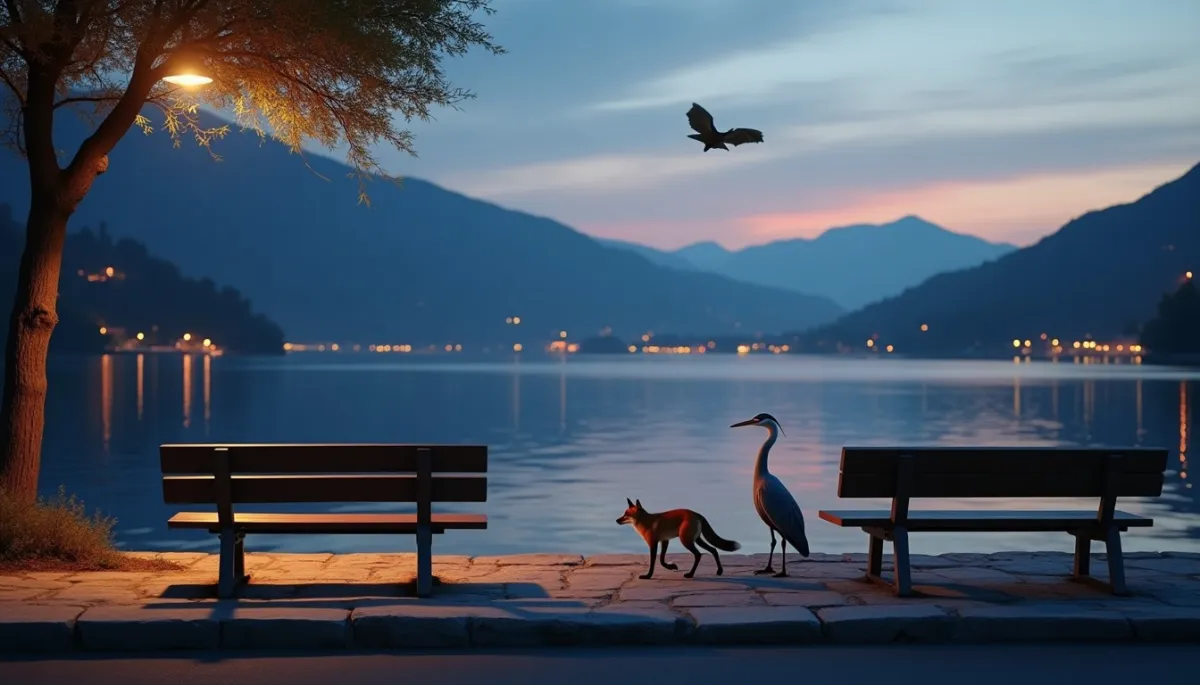
The promenade is empty except for a lamppost's halo, the soft lap of waves against stone, and the sudden, precise silhouette of a bat crossing the path. A fox pads between benches, sniffing for discarded food. Over the water, a grey heron freezes, then dives with the speed of a practiced fisherman. This is the Riviera's other nightlife, staged on our shores while cafés and festivals sleep.
Shadows that feed
Many species are drawn to quays because they concentrate food. Streetlights attract insects, creating easy hunting for bats like the common pipistrelle (Pipistrellus pipistrellus) and noctule bats (Nyctalus noctula).
Aquatic birds, including grey herons and night-time gulls, use the shallow edges to fish when human activity decreases. Swans and coots reclaim quieter inlets to rest. Along rivers feeding into Lake Geneva, beavers and muskrats have been observed increasingly near river mouths, taking advantage of calmer waters and abundant vegetation.
Mammals such as red foxes and stone martens have adapted to urban fringes. The Swiss Federal Office for the Environment (OFEV) notes that these species exploit food resources in towns, and quays provide both cover and foraging opportunities.
Why they come
Quays are linear habitats. Their combination of water, light and human leftovers creates a mosaic that certain animals exploit. Lights draw insects, docks hide prey, and night-time tranquillity reduces disturbance.
Urbanization paradoxically creates new niches. Since the late 20th century, wildlife in Europe has shown surprising resilience. Species that once avoided cities have learned to cohabit, driven by habitat loss elsewhere and the availability of predictable food sources at night.
Citizen science projects on the Riviera, including casual reports to local naturalist groups, have increased awareness of these patterns. Locals commonly report evening fox sightings in Montreux and bat emergence over Ouchy, Lausanne, during late spring and summer evenings.
Conflicts and care
Encounters are not always idyllic. Rubbish left on quays attracts rats and opportunistic carnivores, which can lead to conflicts and disease spread. Feeding wildlife, however well intended, habituates animals and increases risks for both humans and animals.
Conservationists urge simple measures: secure bins, remove food waste, use wildlife-friendly lighting (warmer, shielded lights), and keep dogs on leash at night. These steps reduce negative interactions while allowing animals to use the habitat.
For observers, ethical watching matters. Binoculars, a red-filtered torch, and maintaining silence let you witness bat emergence, fox patrols, and heron hunts without disturbing them. Apps that detect bat calls can add an extra layer of fascination, explaining how echolocation works through high-frequency clicks that humans normally do not hear.
Thanks for reading, and don't forget, Enjoy Life Moments!