Thor Heyerdahl's extraordinary voyage: Crossing oceans on simple reed rafts
🚀 Key Takeaways
- Concept key : Heyerdahl used experimental archaeology to show that simple boats could cross oceans.
- Practical tip : Study traditional boatbuilding and seamanship before attempting sea voyages; safety comes first.
- Did you know : Kon‑Tiki (1947) inspired an Oscar‑winning documentary and a best‑selling book.
He made the ocean his laboratory.
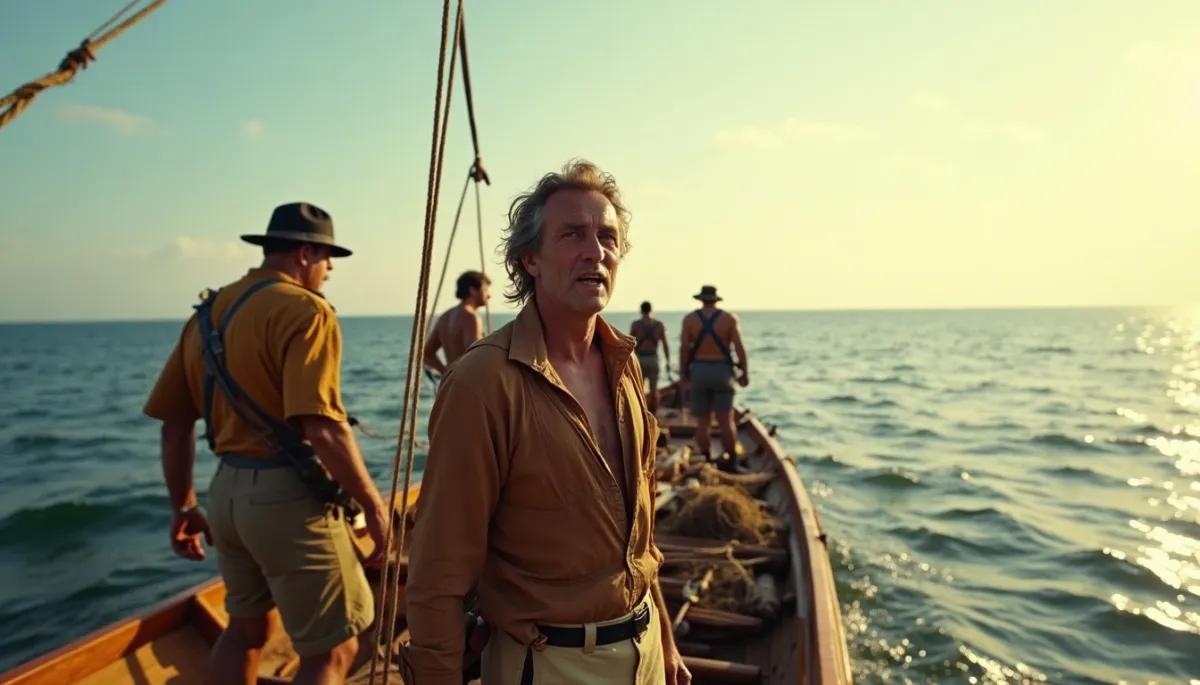
Imagine a tiny raft, sunburned men and a vast blue horizon. Salt stings the eyes. The craft creaks as waves roll under a makeshift sail. Onboard, maps are crude sketches, instruments are primitive, and every sighting of a bird becomes news. That was the world of Thor Heyerdahl when he set out to test whether people in antiquity could have crossed oceans on simple craft.
A man and his rafts
Thor Heyerdahl (1914–2002) was a Norwegian ethnographer and adventurer. He became world famous in 1947 with the Kon‑Tiki expedition, when he sailed a balsawood raft 101 days across the Pacific from Callao, Peru, to the Tuamotu atoll of Raroia.
The Kon‑Tiki crew included six companions: Erik Hesselberg, Bengt Danielsson, Knut Haugland, Torstein Raaby, Herman Watzinger and the leader himself. Their journey began on April 28, 1947, and ended on August 7, 1947. Heyerdahl wrote Kon‑Tiki, published in 1948, and the 1950 documentary film won an Academy Award in 1951.
After Kon‑Tiki, Heyerdahl did not stop. He pursued similar tests with reed boats. In 1969 he launched Ra I, made of papyrus, and after its partial failure, he organized Ra II in 1970, which successfully crossed the Atlantic. Later, in 1977–1978, his reed boat Tigris sailed through the Middle East to illustrate ancient maritime links.
Why he sailed
Heyerdahl's goal was not sensationalism alone. He proposed that contacts between distant cultures could have occurred by accidental or deliberate sea crossings. His central hypothesis challenged mainstream thinking: cultural similarities might be explained by voyages, not only by independent invention or land migrations.
Kon‑Tiki sought to show that South Americans could have reached Polynesia. The raft was constructed using traditional balsa techniques described in pre‑Columbian sources. Its success demonstrated plausibility, if not proof, of such contacts.
With Ra I and Ra II, Heyerdahl focused on reed (papyrus) boats, like those used on the Nile and in Mesopotamia. These experiments showed that papyrus craft, properly built and maintained, could survive lengthy ocean crossings, supporting the idea that ancient peoples had maritime capabilities underestimated by many scholars.
Contradictions and debates
Heyerdahl's methods ignited both admiration and controversy. Experimental archaeology (re‑creating techniques to test hypotheses) earned him fame, but professional archaeologists criticized his tendency to overgeneralize. A successful crossing demonstrates possibility, not historical fact.
Kon‑Tiki proved that a balsa raft could float across the Pacific; it did not establish that such voyages were common or that they led to significant population movement. Likewise, Ra II's Atlantic crossing proved papyrus seaworthiness under controlled conditions, but did not automatically rewrite migration maps.
Yet the value of Heyerdahl's work is pragmatic. He invited the public to imagine ancient voyagers as skillful experimenters. His expeditions inspired decades of research into oceanic drift, traditional boatbuilding and the exchange of technologies. They also popularized maritime archaeology and brought attention to indigenous seafaring traditions.
Stories and moments
There are vivid anecdotes from these voyages. During Kon‑Tiki, the crew filmed an encounter with sharks and navigated by celestial observations and a crude radio. In 1969, Ra I began to disintegrate as seams opened and the crew was forced to abandon ship, an instructive failure that informed Ra II's reconstruction with improved techniques and crew expertise.
Ra II's successful crossing in 1970 was notable for the participation of specialists and local builders familiar with reed boats. Heyerdahl always collaborated with local craftsmen, acknowledging oral traditions and technical knowledge that modern science sometimes overlooked.
Finally, the Tigris expedition ended dramatically when Heyerdahl burned the boat in 1978 as a protest against regional conflicts, a symbolic gesture linking exploration and political conscience.
Practical lessons
Heyerdahl's legacy teaches curious travelers a few concrete things. First, experimental work requires humility: failures teach as much as successes. Second, traditional materials and techniques can be resilient when combined with careful observation and adaptation. Third, safety at sea is non‑negotiable: modern navigation, radios and support vessels are essential for replicating large‑scale experiments.
If you are inspired to learn more, visit maritime museums like the Kon‑Tiki Museum in Oslo, study ethnographic accounts, and if possible, participate in supervised hands‑on workshops on traditional boatbuilding.
Thor Heyerdahl did not claim to have all the answers. He offered bold demonstrations: a way to broaden questions about human curiosity, resilience and the surprising agility of simple technologies on a vast ocean.
Thanks for reading, and don't forget, Enjoy Life Moments!