Unconditional love vs romantic love: building something that lasts
🚀 Key Takeaways
- Core concept : Romantic love fuels desire and novelty, unconditional love offers acceptance and stability.
- Practical tip : Alternate novelty (mini dates, new shared activities) with rituals of care (gratitude practices, boundaries).
- Did you know : Neuroscience shows early romantic love lights up the brain's reward circuit, while steady attachment engages different regions linked to safety.
Love can surprise and calm you at once.
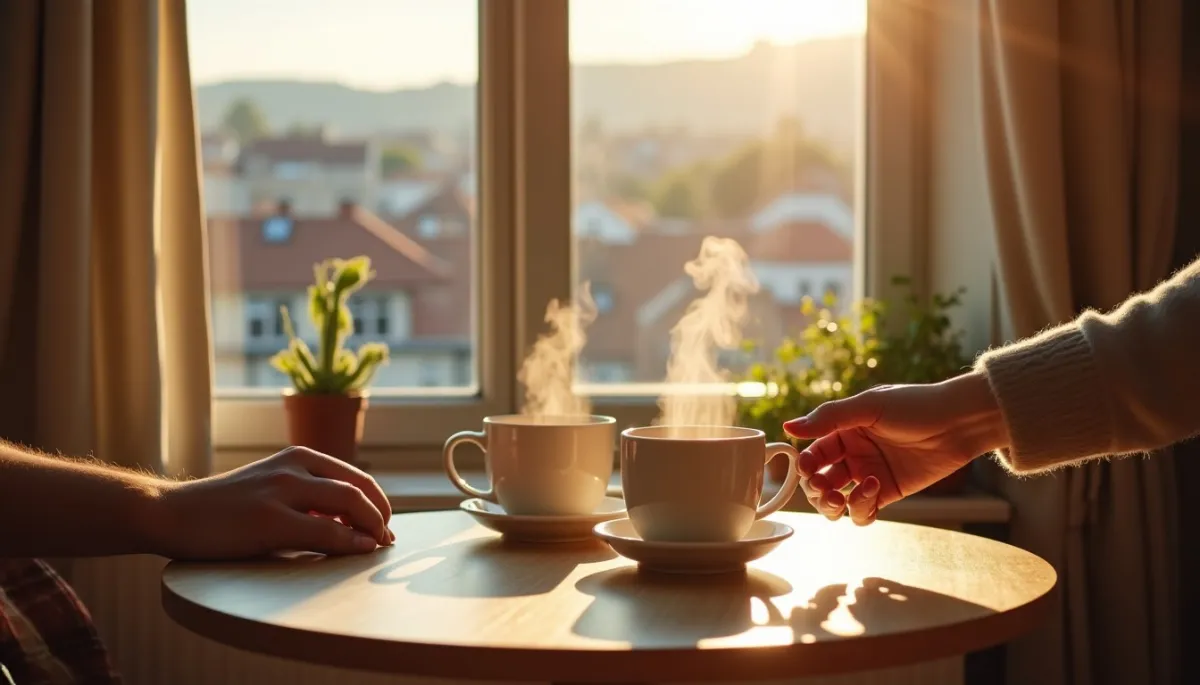
Imagine a small kitchen in Lisbon at dawn, two mugs steaming, one partner reheating yesterday's soup while the other ties a shoelace. They laugh over a private joke, then fall silent when a difficult message arrives. In that silence, one reaches across the table, squeezes a hand without words, and the moment stabilizes. That squeeze may be romantic, but it also gestures toward something broader: a readiness to stay, to tolerate flaws, to support beyond feeling.
When the spark meets the steady
Romantic love is the electric current: excitement, obsession, that sense that the world simplifies around one person. Think of scenes in Stendhal's writings or the fevered lines of early 19th century poetry, where desire becomes an existential center. Modern research, including functional MRI studies, shows romantic passion activates dopamine pathways, the same networks involved in reward and craving.
Unconditional love, by contrast, resembles deep gravity. It is less about fireworks than about orientation: to accept, to bear, to choose consistently. Religious traditions have words for it, from agape in Christianity to loving-kindness in Buddhism. Psychologists link it to secure attachment, the form of love that provides emotional safety and resilience.
In practice, couples describe both. A survey of long-term partnerships often returns stories of early infatuation followed by a quieter, more mutual care. This transition is normal. It does not mean passion vanishes forever, but its role and rhythm change.
Roots and rhythms
Why do these two forms coexist? Evolutionary perspectives suggest romantic love encourages partner selection and bonding, promoting reproduction and short-term focus. Unconditional or attachment-based love supports joint parenting, resource sharing, and long-term cooperation. Both served human societies differently across history.
Social trends amplify the mix. In cities like New York, Tokyo and Paris, the cultural script celebrates individual passion, visible in media and dating apps that reward novelty. At the same time, economic pressures and longer life expectancies make durable partnerships more necessary. The gap between cultural ideal and daily life fuels confusion: many seek the thrill of romance but need the reliability of attachment.
Psychologists such as Robert Sternberg framed love with components (intimacy, passion, commitment). John Gottman's longitudinal studies add concrete signals: repair attempts, soft start-ups, and shared meaning predict longevity. Neuroscience complements this with timing: intense romantic feelings often peak within months to a couple of years, whereas attachment patterns mature slowly with shared experiences.
Strains and reconciliations
Contradictions arise. Expecting romance to carry a relationship alone sets couples up for disappointment. Conversely, treating love purely as duty can extinguish desire. Many separations start when partners feel taken for granted, or when passionate decline is misread as indifference.
Real stories illustrate the mix. A married couple in Madrid I met kept a box of first-date receipts. The box reminded them to occasionally recreate surprise. Another couple in Montreal used weekly 'state of the union' talks, brief and practical, to keep safety high during stressful years. Both approaches fuse the two loves: novelty plus dependable care.
Practical steps help. Keep curiosity alive with new shared activities, travel, small rituals that break routine. Cultivate unconditional elements by practicing empathy, setting and respecting boundaries, and learning repair skills for conflicts. Therapy can be formative; Emotionally Focused Therapy (EFT) aims to transform negative cycles into secure attachment, while sex therapy can restore erotic connection.
Language matters too. Replace 'you should make me happy' with 'I need safety' or 'I miss closeness' and the conversation moves from blame to solution. Rituals of appreciation, weekly date nights, and micro-gestures (a morning message, a touch) accumulate into trust. At the same time, plan novelty: a weekend class, a dinner with no phones, an experiment in role-play.
Long-term construction is not an either-or. Think of relationships as architecture: romantic love is the façade that catches the eye, unconditional love is the foundation. Both deserve care, each with its own maintenance. When balanced, they allow couples to feel alive and anchored, to quarrel and recover, to desire and to forgive.
Thanks for reading, and don't forget, Enjoy Life Moments!