The Rhône before the lake: expedition to the river's source in the Valais glaciers
🚀 Key Takeaways
- Key concept: The Rhône starts at the Rhone Glacier (Rhonegletscher) above Furka Pass in Valais, unfolding over 812 km to the Mediterranean.
- Practical tip: Visit in summer by car or Furka steam railway, take the short walk to the ice grotto and join a guided glacier excursion for safety.
- Did you know: The glacier has retreated more than a kilometre since the 19th century, a visible sign of alpine climate change.
Ice becomes river.
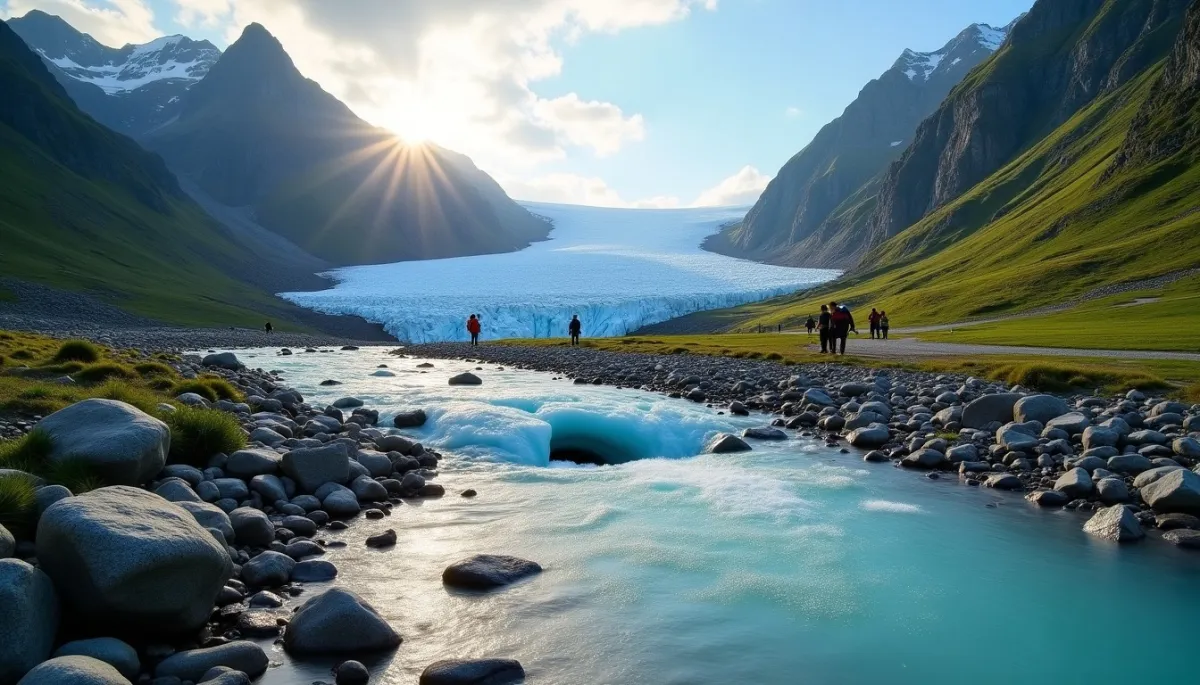
At 2,200 metres, wind bites and the smell of wet stone fills the air. You stand where the ice gives up its secret: a narrow torrent seeping from a blue mouth cut into the Rhône Glacier. Below, water gathers, meets pebbles, and begins a journey that will cross Switzerland and France to the Mediterranean Sea.
Source blanche
The Rhone Glacier (Rhonegletscher) sits above the Furka Pass, in the canton of Valais, its tongue pointing down the valley. From the glacier's melt emerges the nascent Rhône, a clear, cold stream that will grow from rivulet to major European river.
Historical travelers noted this spot for centuries. In the 19th century, early alpinists and naturalists visited the site, and from the late 1800s tourism developed: the glacier cave (an artificial tunnel carved yearly into the ice) became a visitor highlight.
The river's full scale is surprising: the Rhône runs roughly 812 km, drains a basin of nearly 98,000 km², passes Geneva, then Lyon, and finally empties into the Mediterranean in the Camargue. But it starts very small, at an altitude where snow and rock decide the year to come.
Un fil puissant
Consequences of this small origin are enormous. The water that begins here feeds agriculture, industry, cities and delicate ecosystems downstream. Hydropower schemes in Valais and along the Rhône in France depend on summer melt and winter snowpack.
Since the 20th century, engineers, from valley-scale irrigation designers to large hydro companies, have used Rhône waters. The river shapes economies and landscapes, from the terraced vineyards of Lavaux to the canals around Arles.
But the connection is direct: what happens to the glacier affects flows. Reduced ice and altered seasonality change when and how much water runs, with implications for electricity production, agriculture and flood management.
Pourquoi la glace recule
The causes are scientific and local. Rising temperatures across the Alps have accelerated glacier melt. Observations since the 19th century record a steady retreat; the Rhone Glacier has lost well over a kilometre of its length since pre-industrial times (records and photographs made the change painfully visible).
Precipitation patterns have shifted as well. Warmer winters mean more rain at lower altitudes and less accumulating snow on the glacier. A thinner ice mass reacts faster to warm summers, creating a feedback loop of exposure and melt.
Human choices also matter. Land use, tourism, and emissions at continental scale drive the trajectory. Local initiatives (glacier monitoring, information panels, annual ice tunnels) attempt to document change and engage visitors, but the root is global warming.
Regarder demain
However, there are reasons for measured optimism. Scientific monitoring at the Rhone Glacier is robust: Swiss and international teams publish data regularly, and projects to model future scenarios help planners adapt water management and hydropower operations.
On the ground, communities adapt. Seasonal reservoirs, smarter irrigation, and diversified energy portfolios reduce vulnerability. Tour operators offer guided glacier walks with trained mountain guides (the canton recommends using certified guides for any glacier travel).
For visitors, the experience remains visceral and instructive. Walk the short path to the ice grotto dug into the glacier, ride the Furka steam railway in summer for a vintage approach, and stop at the Belvédère viewpoint near Gletsch. Take photos, but also absorb the timeline: postcards from the early 1900s show an ice tongue far larger than today's.
Practical tips: come between June and September; Furka Pass road (2,436 m) is usually open in summer. Respect signs, stay on marked trails, and consider a guided option if you want to approach the ice. Bring warm layers and good shoes; weather changes rapidly.
Visiting the Rhône at its source is more than a scenic detour. It is a lesson in hydrology, history, and human responsibility, where every visitor becomes a witness to the changing Alps.
Thanks for reading, and don't forget, Enjoy Life Moments!