Nietzsche Path in Èze: the cliffside philosophical hike
🚀 Key Takeaways
- Core concept: A short, steep trail (about 2 km, 400 m ascent) linking sea to village and memory.
- Practical tip: Start from Èze-sur-Mer station, wear sturdy shoes, bring water, avoid midday heat in summer.
- Did you know: The path is associated with Friedrich Nietzsche, who visited Èze in 1883 and hiked the area while composing notes.
Light, wind and a white ribbon of stone — that is the first thing you meet on the Sentier Nietzsche.
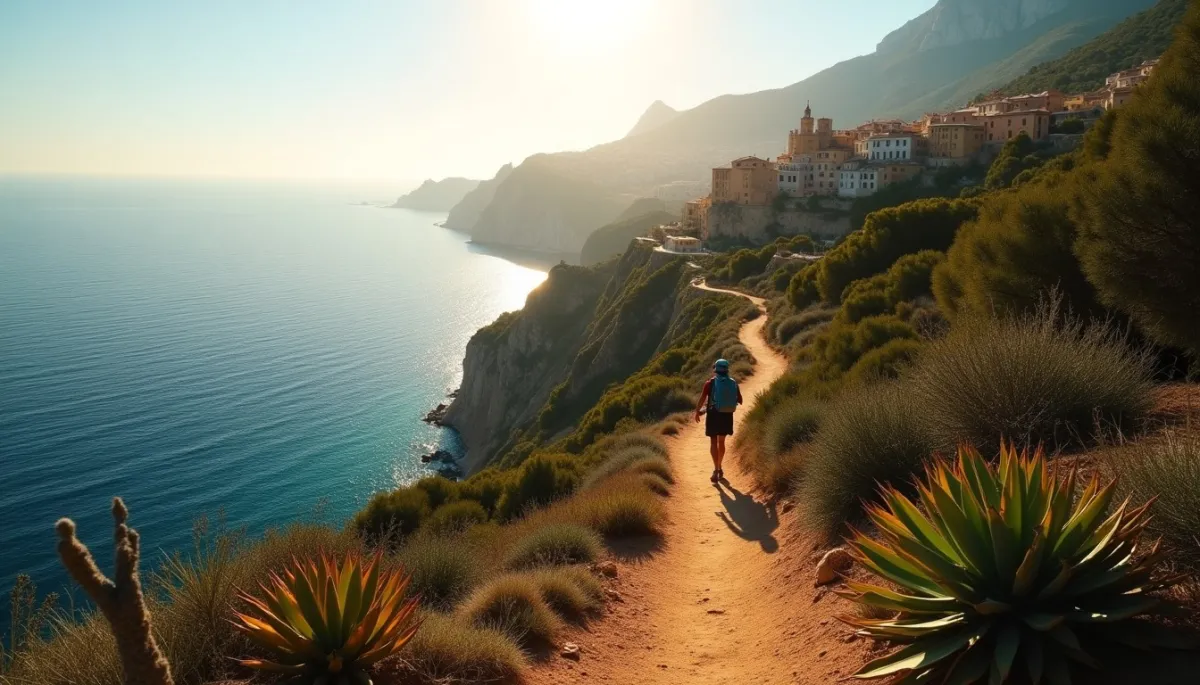
Picture a narrow trail carved into a cliff face, overlooked by agaves and small cacti, the blue of the Mediterranean spread below like a promise. Hikers pause at belvederes, phones down, letting the view settle before them: Cap Ferrat to the left, Monaco on the horizon, the coastline folding like a map of light. Above, the old village of Èze crowns the ridge at about 427 meters above sea level.
Path and panorama
The Sentier Nietzsche connects Èze-sur-Mer (near the train station) to the perched village of Èze. It is roughly 2 kilometers long with an elevation gain close to 400 meters, depending on where you start and end.
Walking time is typically between one hour and an hour and a half for the ascent, longer if you stop for photos and the Jardin Exotique. The route alternates stone staircases, rocky steps and shaded stretches beneath Mediterranean scrub.
Along the way, small plaques and viewpoints recall Nietzsche's visits during the late 19th century. Whether you look for philosophy or simply a breathtaking panorama, the trail delivers a strong sense of suspension above the sea.
Thought and terrain
Why associate a hiking path with a philosopher? Nietzsche came to the Riviera several times, notably in 1883, seeking climate and solitude. The sharp contrasts of light and sea, the isolation of a hilltop village, suited his reflective temperament.
For walkers today, the Sentier Nietzsche is a literal meeting of body and idea. The exertion of climbing, the rhythm of breath, the sudden openings onto the horizon create small moments that encourage reflection, as if nature were inviting thought to catch up with the feet.
The path is also a cultural thread across Èze's history: a medieval hamlet perched since the Middle Ages, panoramic gardens that amplify the view, and nearby ateliers de parfumerie such as Fragonard, which recall the region's olfactory traditions.
Practical echoes
Start early in summer to avoid heat, or choose late afternoon for golden light. The nearest train stop is Èze-sur-Mer; from there the path climbs almost directly toward the village. Parking in Èze-village is limited, so public transport is often easier.
Wear sturdy shoes, bring water, and expect uneven stone steps. If you have mobility issues, the ascent can be demanding; alternatively, a bus or taxi will bring you to the village with less effort.
Combine the hike with a visit to the Jardin Exotique d'Èze for plants adapted to rocky, sun-drenched sites, and finish with a tour at Fragonard or a café terrace in the village to savor the view and reflect on your walk.
Thanks for reading, and don't forget, Enjoy Life Moments!