Montreux's mild winters: why the Riviera has its own microclimate
🚀 Key Takeaways
- Key concept : Lake effect and local topography moderate temperatures.
- Practical tip : Walk the lakeside early in the morning for mild light and few tourists.
- Did you know : Lavaux terraces (UNESCO, 2007) owe part of their vine culture to this warm pocket.
Winter here has a gentle voice.
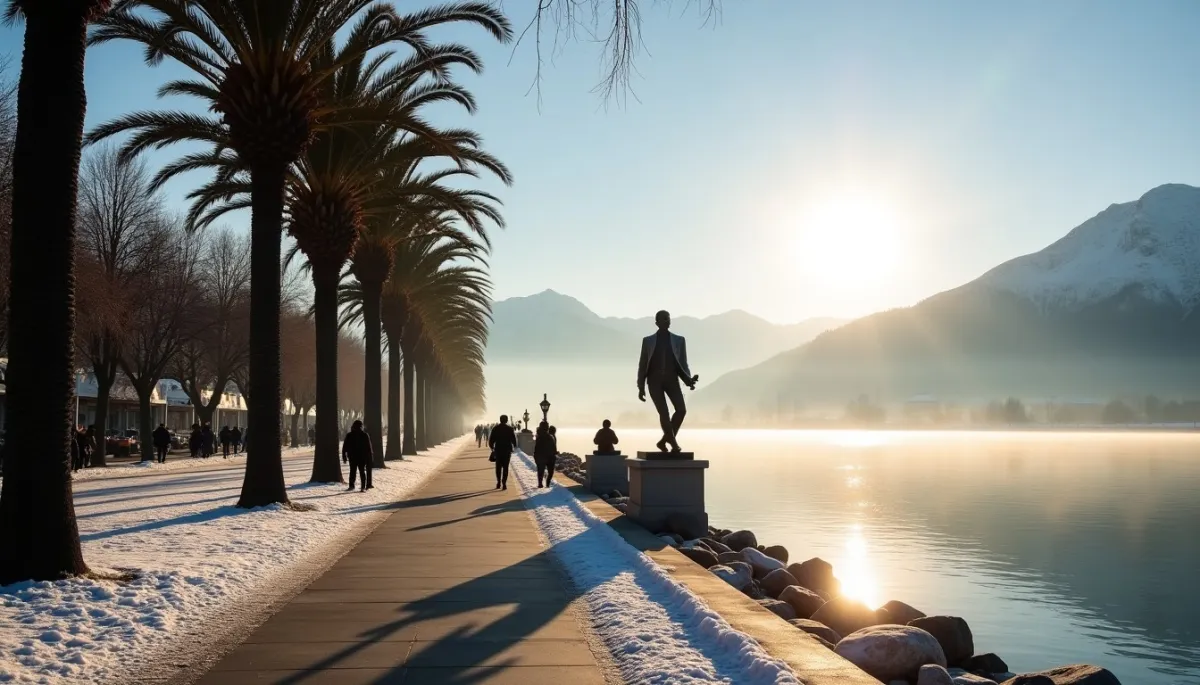
Imagine strolling the Montreux promenade in January, breath visible in the cold but your hands comfortably bare, palms lining the walkway, the white crowns of the Dents-du-Midi and the Alps glinting across Lac Léman. Steamers glide by, and the Freddie Mercury statue gazes toward the water, while café terraces still host a few sun-seekers under blankets and small heaters. That contrast between alpine snow and lakeside mildness is the Riviera's calling card.
Douceur au rivage
Montreux, Vevey and the surrounding Riviera are famous for winters that feel more like extended autumn than harsh midwinter. Average January temperatures tend to hover around just above freezing on the shoreline (commonly 1 to 4 °C), a figure noticeably higher than at similar altitudes inland. Snowfalls on the shoreline are sporadic and usually melt quickly, while higher slopes keep a solid winter cover.
This warmth changes life. Olive and palm trees thrive along the lakeside promenades, oleanders bloom late into autumn, and the historic vineyards of Lavaux profit from a longer vegetative season. Tourism follows the climate, with winter walks, thermal comfort in hotels and cultural events such as the Montreux Jazz Festival planning off-season visits around milder months.
The human story is long. Since the 19th century, British and European visitors praised Montreux as a healthful winter refuge. Steamship timetables and Belle Époque hotels were built for those who wished to escape harsher continental cold, and the urban landscape still reflects that era's belief in the curative power of mild lakeside air.
Le lac qui retient la chaleur
At the heart of the phenomenon is Lac Léman's thermal inertia. Large bodies of water change temperature slowly, storing summer heat that releases through autumn and winter. The lake acts as a heat reservoir, moderating night-time drops and reducing frost frequency along its shores.
Topography amplifies the effect. Montreux sits on south-facing slopes that receive generous sunshine, and the high Alps to the east block some cold air masses. Narrow valleys channel warmer air down toward the lake, creating pockets where temperatures are consistently milder than in surrounding regions.
Local winds also play a role. The foehn (a warm, dry downslope wind) can raise temperatures rapidly when it blows, evaporating snow and brightening the day. Conversely, the lake can generate humidity and local breezes that further temper extremes, a microclimate interplay of water, mountain and wind.
Racines et paysages
Human activity has both taken advantage of and reinforced the Riviera's climate. Viticulture on the Lavaux terraces (inscribed UNESCO, 2007) developed because vines find these sun-trap slopes and mild winters favorable. Stone walls store heat and protect roots from cold, a technique honed over centuries.
Horticulture, too, has adapted. In the 19th and early 20th centuries, exotic plants were introduced by wealthy winterers, and many have persisted. Today, you can see palm-lined promenades, cypress markers and subtropical gardens that would look out of place a few kilometers inland.
Culture and music have a place in the story. Mountain Studios in Montreux attracted bands such as Queen in the 1970s and 1980s, drawn as much by the setting as by the studio. The combination of mild winters and inspiring scenery helped make Montreux a year-round creative refuge.
À garder en tête
However, the mild winters are not guaranteed forever. Climate change complicates the picture. Warmer average temperatures can mean less predictable snow and altered precipitation patterns, which affect vine cycles and water management for vineyards and towns.
Local planning responds with adaptive measures. Vine growers increasingly monitor vine phenology (the timing of budburst, flowering and harvest) to adjust practices. Municipality services prepare for sudden thaw-freeze cycles that can damage roads and infrastructure, and conservation groups work to preserve fragile lakeshore habitats from invasive species that benefit from warmer water.
For visitors, the takeaway is simple. Montreux's mild winters create a unique, pleasant winter experience: walkable promenades, accessible cultural sites like Château de Chillon, and panoramic train routes along Lavaux. If you cherish gentle winter light and a blend of alpine and Mediterranean atmospheres, the Riviera is a winter destination worth timing between December and March, when you can enjoy quieter streets and still-lively cultural life.
Merci d'avoir lu, et n'oubliez pas, Profitez des moments de la vie !