Marie and Pierre Curie: a fusion of science and a love stronger than death
🚀 Key Takeaways
- Core idea : Partnership in discovery and life produced breakthroughs in radioactivity.
- Practical tip : Visit the Musée Curie in Paris and the Panthéon to trace their footsteps; book ahead.
- Did you know : Marie coined the term "radioactivity" in her 1898 doctoral work.
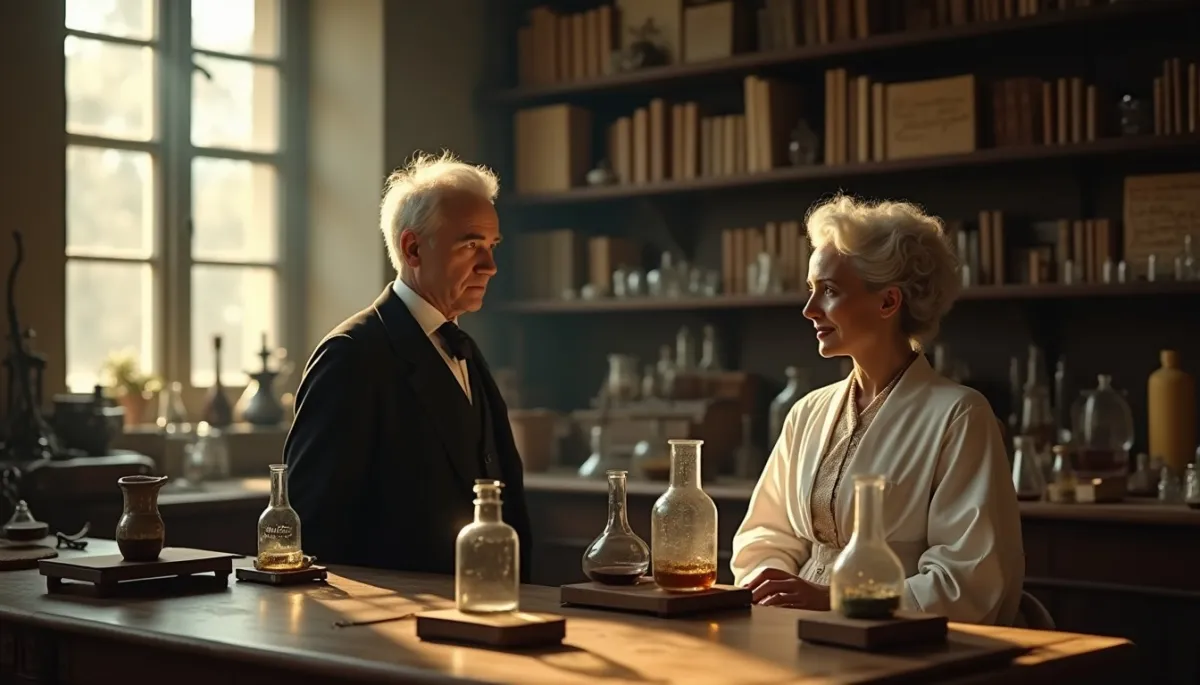
They worked, loved, and calculated together. Imagine a small Parisian laboratory, glass flasks fogged, a lamp on the bench, two figures bent over a balance, whispering about a faint glow in a vial.
Un couple au laboratoire
Marie Skłodowska Curie (born 1867 in Warsaw) and Pierre Curie (born 1859) formed a scientific duo whose names are imprinted in the history of physics. Married in 1895, they announced, in 1898, the discovery of two new radioactive substances: polonium and radium.
Pierre had already made key contributions to crystallography and, with his brother Jacques, discovered piezoelectricity in 1880. Marie brought rigorous chemical methods and an extraordinary persistence; together they isolated measurable radioactive emissions and quantified them.
Their achievements led to the Nobel Prize in Physics in 1903, shared with Henri Becquerel. Later, Marie received the Nobel Prize in Chemistry in 1911 for her work on radium and polonium, the first person to win two Nobel prizes in different sciences.
Comment ils y sont arrivés
Their path combined talent, sacrifice and long hours. Marie left Warsaw to study at the Sorbonne, where she graduated in physics in 1893. Pierre was already established in the Paris scientific scene; they met through academic circles and married quickly, finding in each other both a companion and a collaborator.
Working in makeshift spaces, often cold and poorly equipped, they processed tons of pitchblende ore to isolate tiny amounts of new elements. In 1898 they named polonium after Marie's homeland, Poland, a symbolic gesture of identity and resistance.
Marie also introduced the term "radioactivity" (radioactivité) in her 1898 doctoral thesis. That neologism describes the spontaneous emission of particles or energy by unstable atomic nuclei. Explaining simply, an unstable atom releases bits of itself to become more stable; those emissions can be measured and harnessed.
Un amour éprouvé par la mort
Tragedy struck in 1906 when Pierre died after being run over by a horse-drawn carriage in Paris. Marie later described the loss as the tearing away of a part of her existence. Despite grief, she continued their work and succeeded Pierre as professor at the Sorbonne.
She expanded their laboratory's mission, isolating radium in forms that allowed further study. During World War I she organized mobile X-ray units and trained about 150 radiology operators, helping surgeons save countless lives on the front.
Their legacy went beyond discoveries. Their daughter Irène Joliot-Curie later shared a Nobel Prize in Chemistry in 1935 with her husband Frédéric Joliot. In 1995, Marie and Pierre Curie were interred in the Panthéon in Paris, a national recognition of their impact.
Contradictions et héritage
Their lives reveal a paradox: the source of medical progress also carried hidden danger. Many of their original notebooks and personal effects remain radioactive to this day and are kept in lead-lined boxes. Their hands-on approach, carrying and measuring radioactive materials, likely contributed to health problems, including Marie's death by aplastic anemia in 1934.
Yet their curiosity and courage opened new fields. Radioactivity led to radiotherapy, nuclear medicine, and deeper atomic physics. It also raised ethical and safety questions that the scientific community continues to address.
Practical advice for modern visitors: the Musée Curie (1, rue Pierre et Marie Curie, Paris) preserves instruments and tells their story. Wear comfortable shoes, reserve tickets, and follow museum guidance about touching exhibits. For conversations at dinner, mention that Marie's biography by her daughter Ève Curie (1937) remains a moving personal account.
Marie and Pierre Curie exemplify how collaboration, modesty and persistence can produce discoveries that change the world, and how love can outlast death when people build a shared mission together.
Thanks for reading, and don't forget, Enjoy Life Moments!