Green urbanism: how surrounding yourself with plants transforms mental health
🚀 Key Takeaways
- Concept key : Urban greenery reduces stress and lowers risks of some psychiatric disorders.
- Practical tip : Aim for 120 minutes a week in green spaces, and start with easy houseplants or a balcony box.
- Did you know : Projects like New York's High Line or Singapore's 'City in a Garden' show diverse models to add nature in dense areas.
Green changes everything.
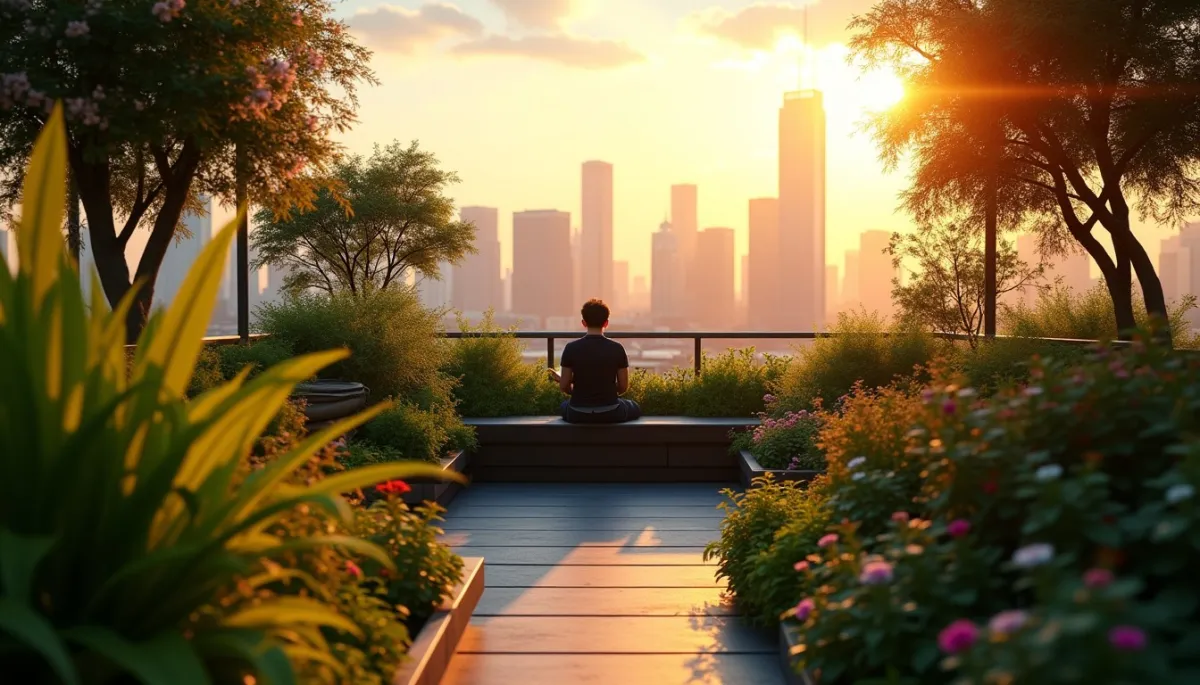
Imagine waking up in a sixth-floor apartment, the city still humid from the night, and moving past a row of potted ferns to a window that frames a maple-lined street. Cars sound distant, birdsong edges in. A neighbor waters a communal planter on the balcony. That small scene, repeated across blocks, transforms how a city feels and how its people live.
Cities renewed
Urban green is no longer decorative. Since the 1980s, researchers have documented measurable benefits. In 1984, Roger Ulrich published a landmark study showing hospital patients with a window view of trees recovered faster after surgery than those facing a brick wall. That result launched decades of inquiry into nature's therapeutic role.
More recently, a 2019 study led by Kristine Engemann (PNAS, 2019) found that growing up with more residential green space was associated with lower risk of several psychiatric disorders later in life. Another major review (White et al., Scientific Reports, 2019) identified that about 120 minutes per week in nature correlates with better health and wellbeing.
Examples are concrete. New York's High Line, inaugurated in stages from 2009, turned an abandoned rail into a planted promenade that changed adjacent neighborhoods. Milan's Bosco Verticale, completed in 2014, planted apartment towers with hundreds of trees and became both symbol and proof that biodiversity can be integrated into dense housing.
Roots of change
Why now? Rapid urbanization, rising mental health needs, and climate pressure converge. By 2025 more than two thirds of the world's population will live in cities, according to UN data, intensifying isolation and stressors linked to urban life. Green infrastructure answers multiple challenges at once.
Science offers mechanisms. The biophilia hypothesis explains a human affinity for nature. Attention Restoration Theory suggests natural environments replenish cognitive resources depleted by city demands. Physically, vegetation reduces air pollution, mitigates urban heat islands, and buffers noise, all factors that indirectly support mental health.
Policy momentum follows evidence. Singapore's long-term 'City in a Garden' program has increased tree cover and connected green corridors since the 1990s. Paris popularized the '15-minute city' concept around 2020, encouraging localized access to green spaces and services. These strategies show how planning choices shape daily exposure to nature.
Limits and futures
Green urbanism is powerful, but unevenly distributed. Low-income neighborhoods often have less canopy and fewer parks, which perpetuates health inequalities. A 2016 WHO brief emphasized that access to high-quality green space is a social justice issue and must be planned equitably.
There are also trade-offs to manage. Gentrification can follow greening projects, pushing out residents they aimed to help. Cities need inclusive governance, community land trusts, and deliberate policies to preserve affordability as they add trees and parks.
Technological and design innovations can expand options. Living walls, pocket parks, and modular planters enable greenery on narrow streets. Schools and hospitals that incorporate gardens report reduced stress in children and staff. The lesson is pragmatic: scale matters, but small interventions accumulate.
Practical green steps
Start small. Choose resilient plant species for apartments, such as pothos, snake plant or ZZ plant, which tolerate variable light and help filter indoor air. For balconies, mix native shrubs with flowering annuals to support pollinators.
Commit to time in nature. If 120 minutes per week sounds abstract, split it into four 30-minute visits to a park, or a daily lunchtime walk under trees. Track it like another habit and notice mood shifts over weeks.
Engage locally. Volunteer for a tree-planting day, join a community garden, or advocate for more street trees at city council meetings. Collective action ensures greening is sustained and benefits many.
Thanks for reading, and don't forget, Enjoy Life Moments!