Grandma Moses: starting to paint at 78 and becoming a global icon
🚀 Key Takeaways
- Key concept : Late-blooming creativity can produce lasting cultural impact.
- Practical tip : Start small, use materials at hand, document your progress.
- Did you know : Grandma Moses created over 1,500 paintings and lived to 101 (1860–1961).
Beauty arrived late, but it arrived with color and joy.
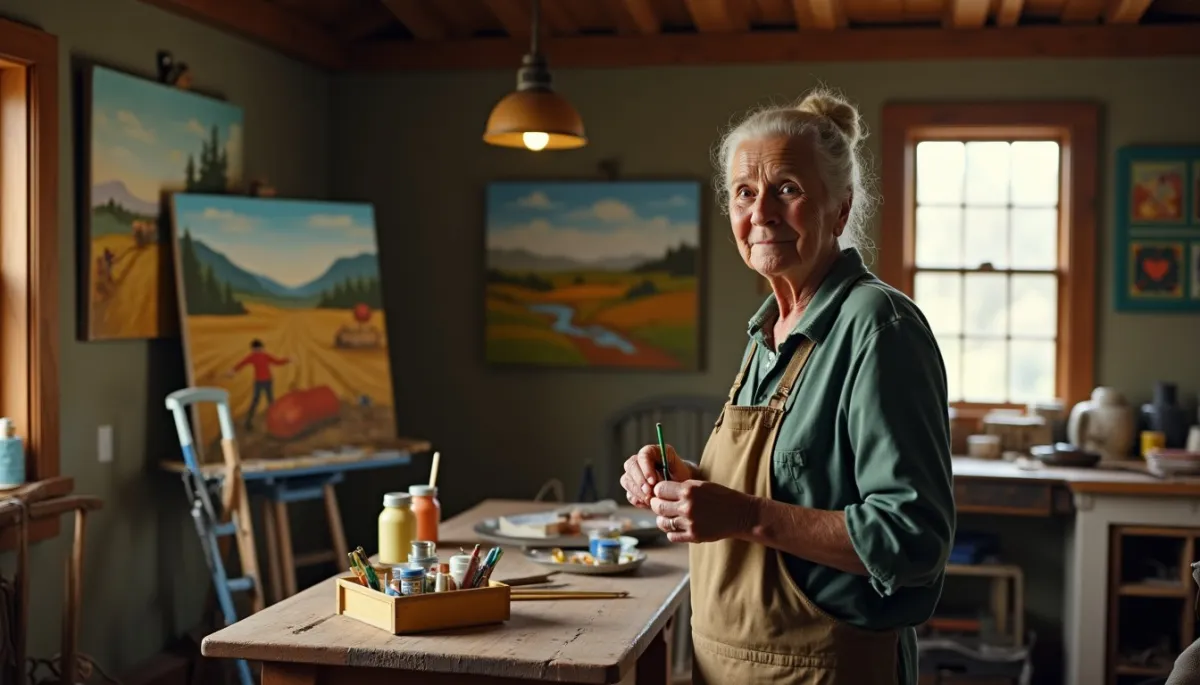
Imagine a small farmhouse kitchen in upstate New York, sunlight through lace curtains, a tabletop crowded with jars of jam, a battered tin of brushes and, leaning on the wall, paintings of sledding parties and harvest fields. An elderly woman, hair in a bun, concentrates on a tiny house rendered in bright, deliberate strokes. That woman would become Grandma Moses.
A humble beginning
Anna Mary Robertson was born in 1860 and lived most of her life in rural New York and Vermont. She spent decades sewing, tending a farm and raising children. Painting was not her first vocation.
It was only in her late seventies, when arthritis made embroidery painful, that she turned to painting. Using household paints and scraps of board or canvas, she translated memories of country life into scenes full of movement and anecdote.
Her work is classified as American folk art or naïve painting. These labels describe art made outside formal academic training, where perspective and proportion follow personal logic rather than studio rules.
The rise to fame
Grandma Moses's paintings attracted local attention, then the notice of collectors and dealers in the 1940s. Newspapers and magazines began to write about the elderly artist who depicted American rural customs with warmth and detail.
By mid-20th century she exhibited in New York and her images were widely reproduced on calendars and greeting cards. The simplicity of her scenes—ice skating, apple picking, community quilting—spoke to a post-war audience nostalgic for a perceived simpler life.
Across her career she produced more than 1,500 works. Her signature, "Grandma Moses," became a brand and a symbol of resilience, proving that recognition can come at any age.
Contradictions and continuities
Her fame raised questions: was the public celebrating authentic folk expression or an idealized myth of rural America? Critics sometimes dismissed her as sentimental, while museums and buyers celebrated the sincerity and narrative power of her compositions.
Grandma Moses navigated the commercial and the personal. She adapted to demand without losing the autobiographical core of her scenes. Her works became objects of mass culture, yet each painting remained a personal recollection.
She died in 1961 at age 101, leaving a legacy that still fuels debates about outsider art, authenticity and the value of life experience in artistic creation.
Lessons and tips
Her life suggests practical advice for anyone wanting to start late: use what you have, borrow motifs from daily life, and don't wait for permission to begin. Materials can be simple: household paints, wood panels or paper.
Document your journey. Photographs, dates and short notes increase the value of work and make it easier to show progress to friends, galleries or online communities.
Finally, lean on community. Local fairs, senior centers, and online groups can turn a private practice into public opportunity, just as happened for Grandma Moses in the 1940s.
Thanks for reading, and don't forget, Enjoy Life Moments!