Mental minimalism: how to declutter your brain in a saturated world
🚀 Key Takeaways
- Core concept : Reduce cognitive clutter by limiting inputs and organizing attention.
- Practical tip : Try a weekly information fast and a two-minute brain dump each morning.
- Did you know : The notion draws on cognitive psychology and recent books like Cal Newport's "Digital Minimalism" (2019).
Close your eyes for a second. Imagine the ping of a message, the news headline, the meeting alert, all vying for a single thought.
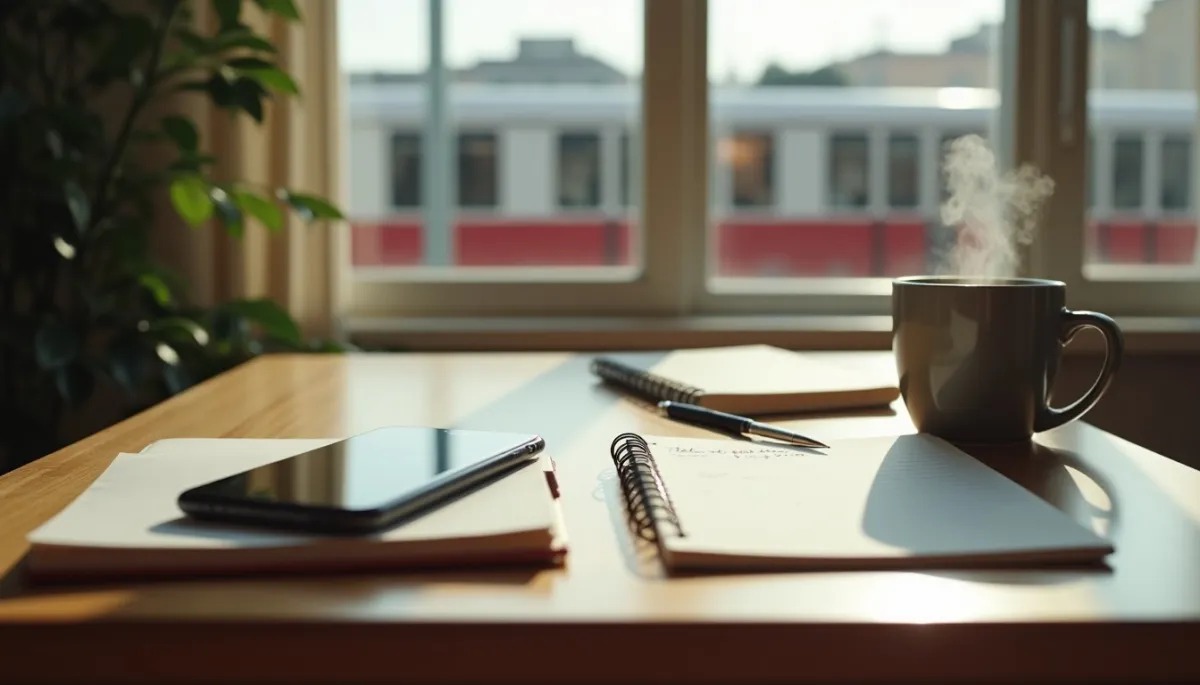
You are at your kitchen table. Outside, a tram rattles by on a rainy Thursday. Your phone lights up with seven notifications at once. On the table a grocery list shares space with an unfinished project brief. The scene feels familiar: fragments demanding completion, an inner to-do list that keeps replaying. That tension is the starting point of mental minimalism, a movement that treats the mind like a workspace to clear and maintain.
Esprit encombré
The modern mind carries more than memories. It carries unfinished tasks, open tabs, social obligations, and an archive of alarming headlines. This cognitive load can translate into anxiety, reduced productivity, and sleep disturbance.
Research in cognitive psychology shows limits to working memory. Early work by George Miller in 1956 suggested a narrow capacity for information chunks, and later studies refined the idea: attention is a scarce resource. Sophie Leroy's 2009 work on attention residue explains why switching between tasks leaves mental fragments behind, reducing effectiveness.
In everyday terms, mental clutter looks like list anxiety, repeated checking, and the nagging sense of forgetting something important. For many professionals in cities like New York, Paris or Mumbai, it is the default state rather than the exception.
Racines visibles
The causes are both technological and cultural. Since the 2010s, the smartphone era multiplied touchpoints. In 2014, the English edition of Marie Kondo's book popularized decluttering possessions, and by the late 2010s, thinkers turned that lens to attention.
Cal Newport's 2019 "Digital Minimalism" helped name a trend: curating digital habits to regain focus. Around the 2020 pandemic, remote work and rising screen time accelerated cognitive saturation, sending many readers to low-information diets and scheduled deep work sessions popularized by knowledge workers.
Economic and social incentives also push content density. Algorithms reward engagement, which often means outrage, novelty, and rapid cycles of updates. That creates a background hum that competes with reflective thought and long-term planning.
Signes et paradoxes
Yet minimalism of the mind is not about emptying thought entirely. It is selective. The paradox is that adding intentional limits creates more freedom. People who adopt these practices report greater creativity and better relationships.
Some contradictions appear in public discussions. A tech executive may advocate digital declutter while designing attention-grabbing products. Artists might embrace solitude for creation, but rely on social platforms for exposure. These tensions show the approach is pragmatic, not dogmatic.
Future debates will likely focus on equity: who can afford solitude and time? In 2021 and 2022, local communities and workplaces experimented with 'no-meeting days' and email curfews to protect cognitive space. Such policies suggest institutional ways to scale mental minimalism beyond personal rituals.
Rituels pratiques
Start small. A two-minute brain dump each morning clears short-term memory by listing tasks and worries on paper. This simple ritual externalizes mental items and reduces repetition.
Try a weekly information fast. Choose one day or half-day without news or social media. Many report that an evening without feeds leads to deeper sleep and calmer mornings. Tim Ferriss mentioned the idea of a 'low-information diet' in his 2007 writings; the principle remains useful.
Design your environment. Limit notification types, create physical inboxes for paper, and schedule single-task deep work blocks of 60 to 90 minutes. Use labels like 'decide later', 'delegate', or 'delete' when processing incoming requests.
Voies inspirantes
Real stories help. A Parisian teacher I interviewed in 2023 reduced email checking to two windows per day and reclaimed evenings for reading. A software designer in Berlin uses a locked drawer for her phone during creative work, and reports more original ideas in a month than in the previous year.
Historical echoes exist. Monastic traditions practiced silence and deliberate attention long before the internet. The difference today is that we must create those conditions within dense social and technological networks.
Minimalisme mental is neither ascetic nor trendy. It is a set of practices you can adapt: schedule attention, externalize memory, and protect restorative time. The goal is simple: to make space for what matters.
Thanks for reading, and don't forget, Enjoy Life Moments!