The mystery of chasselas: why Lavaux's emblematic wine hardly travels
🚀 Key Takeaways
- Key concept : Chasselas is highly local, consumed mainly in Switzerland.
- Practical tip : Buy directly from cellars in Lutry, Cully or Rivaz for true terroir expressions.
- Did you know : Lavaux terraces cover about 830 hectares and became UNESCO listed in 2007.
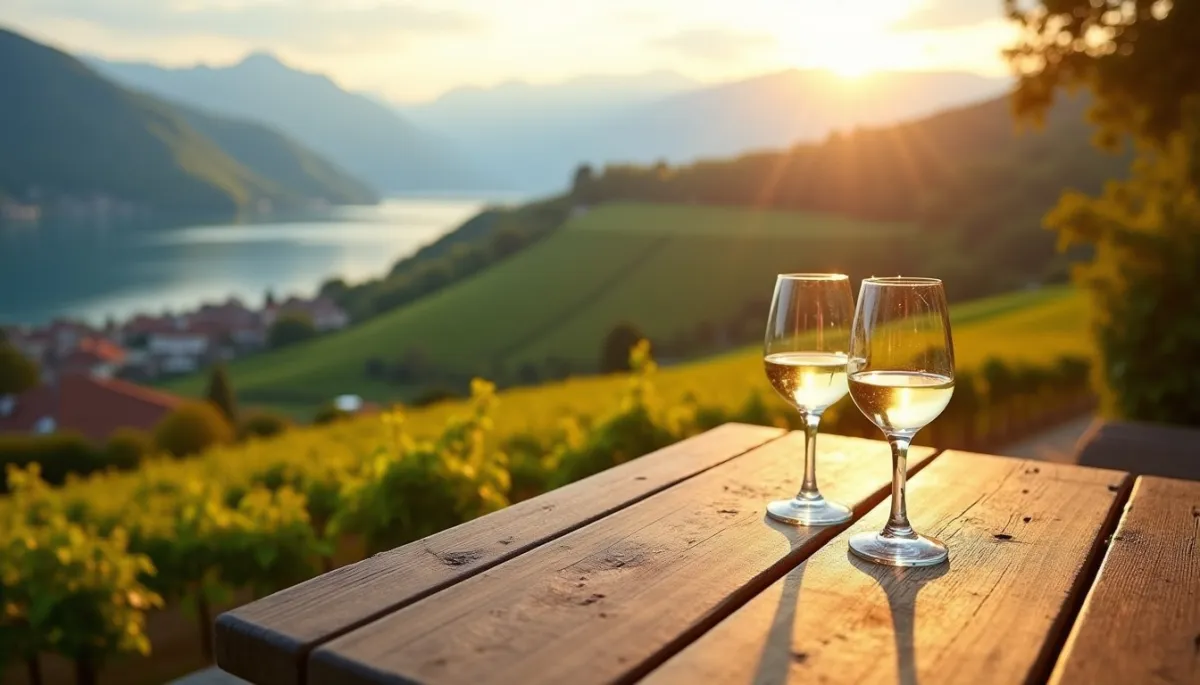
Soft gold in the glass. Imagine a small wooden table on a Lavaux terrace at dusk, two glasses catching the last sun over Lake Geneva.
rare and local
Chasselas is a companion of daily meals here, not a global ambassador. In restaurants from Lausanne to Montreux, it dominates wine lists and kitchen pairings, often poured by the carafe rather than the bottle of prestige.
Lavaux, with roughly 830 hectares of steep terraces carved between Lausanne and Vevey, presents a dense production for a small market. The UNESCO listing in 2007 boosted tourism, but not necessarily exports.
Statistics tell a simple story: Swiss wine, and Chasselas in particular, is mostly drunk at home. Only a few percent of total production crosses the border, compared with many wine regions that rely heavily on export volumes.
why it stays
Part of the answer is cultural. Chasselas (also known as Gutedel in German-speaking areas and Fendant in parts of Valais) is prized for its subtlety and versatility. It shines paired with raclette, perch filets and local charcuterie, dishes that are not ubiquitous on foreign tables.
Another reason is scale and structure. The vineyards of Lavaux are mainly family-run plots on steep slopes. Mechanization is limited, yields are moderate, and many parcels are tiny. That makes economies of scale hard to achieve for mass export.
Economic factors also weigh in. A strong Swiss franc, production costs on terraces, and relatively small volumes push retail prices upward. Importers abroad often prefer wines with clearer storytelling around varietal intensity or high-profile appellations, and Chasselas’ gentle profile can be misread as neutral.
contradictions and momentum
Yet the story is not static. The same delicacy that hinders mass appeal becomes a selling point in niche markets seeking elegance and terroir. Sommeliers in London and Berlin have started to feature single-parcel Chasselas from St-Saphorin or Lutry to show lake-influenced minerality.
Winemakers are experimenting. Some producers age Chasselas on fine lees, use oak sparingly, or create cuvées from old vines to amplify identity. Cooperative cellars occasionally bottle terroir-driven ranges aimed at export fairs and gastronomy events.
Public initiatives and wine tourism help. The Fête des Vignerons of 2019 brought international attention to Vaud’s wine culture, and routes like the Lavaux Vinorama and the route des vins encourage visitors to buy bottles to take home, turning tourists into micro-ambassadors.
what to do as a visitor
If you travel to Lavaux, taste widely. Ask for village or lieu-dit bottlings (single-site wines). Those show differences in soil, sun exposure and vine age better than generic labels.
Buy from the cellars in Cully, Lutry or Rivaz. Many producers ship within Europe on request; some boutique importers in France and Germany already stock select cuvées.
Finally, bring a story. Chasselas thrives when served with local food and conversation. Export may be slow, but the best strategy is experiential: sip here, tell friends abroad, and the grape will travel, one glass at a time.
Thanks for reading, and don't forget, Enjoy Life Moments!