3 Innovations Presented at the "A World for Travel" Forum That Are Reinventing Tourism
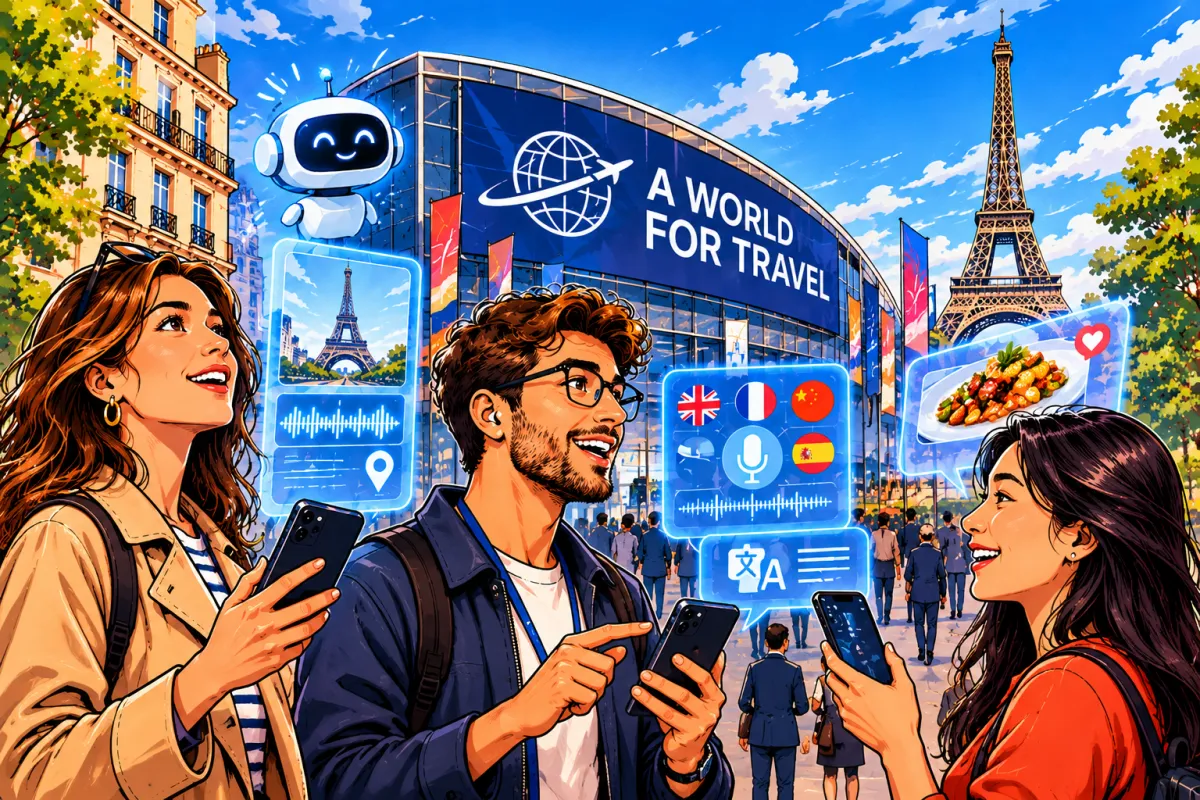
At the A World for Travel forum in Paris on October 29 and 30, 2026, artificial intelligence (AI) is emerging as the driving force behind a new era of tourism. Interactive tours, instant translation, and culinary experiences: here’s a closer look at three innovations spotted at the event that are transforming the traveler’s experience.
1. Guidly: The Interactive, Customizable Virtual Audio Guide
Gone are the days of standardized tours and monotonous audio guides. Created byKenza Yahioui, a computer engineer with a passion for travel,Guidly is reinventing the travel companion with a smart app capable of generating dynamic audio tours anywhere in the world.
Born out of a personal need to address the high cost and lack of flexibility of traditional guides, the app now lists more than 9 million points of interest across the globe.
As soon as a user wanders through a city, Guidly detects their location to help them discover iconic landmarks as well as the neighborhood’s hidden gems. The true innovation lies in its real-time personalization engine, built around four specific criteria:
-
Language: 12 built-in languages (European languages, Arabic, Chinese, Japanese, etc.).
-
The tone of the tour: Free choice between an academic style worthy of a history professor or a playful tone peppered with anecdotes.
-
Level of detail: From a quick overview to an in-depth historical analysis.
-
Areas of interest: Standing in front of the Eiffel Tower, a foodie will hear about its legendary restaurants, while an art lover will enjoy a focus on the architecture.
“The goal is to do away with boring audio guides. Our information is verified and continuously updated. Most importantly, users can interact directly by asking questions out loud, just as they would with a human guide,” explains Kenza Yahioui.
Available on iOS and Android for independent travelers, Guidly is also appealing to travel agencies and tour operators, who are integrating it directly into their travel packages.
2. Glot: Breaking Down Language Barriers and Making Events Accessible
In a globalized tourism sector, language barriers and a lack of accessibility remain major obstacles. To address this dual challenge,Majid El Bouchi createdGlot, a simultaneous translation technology powered 100% by artificial intelligence.
Originally designed for conferences, conventions, and trade shows, the platform allows speakers to express themselves in their native language while ensuring the audience fully understands them.
“By simply scanning a QR code, everyone can select their language and listen to the live translation through their headphones. To ensure full inclusion, we offer audio translation, subtitles on smartphones and large screens, sign language avatars, and displays adapted for people with dyslexia,” emphasizes Majid El Bouchi.
An agile solution for the tourism industry
With more than300,000 users served, Glot does not aim to replace interpreters at high-level diplomatic summits, but provides a practical solution for mid-sized events (10 to 500 participants) that lack the budget for large-scale systems.
This innovation is now finding major applications in transit tourism. In particular, Glot is conducting a pilot program at an international airport: a foreign traveler can scan a QR code to communicate seamlessly with customer service agents or reception staff, instantly resolving emergencies or providing directions.
3. A Promising Student Project: Combining Gastronomy and Social Interaction Through AI
Presented under the working title “FoodSwipe,” this concept—still in the prototype stage—is being developed by a group of three students and their professor, represented at the forum byGonçalo Teixeira. The app has not yet been launched online or marketed to the general public, but its ambition has already caught the attention of travel tech observers.
What is the goal of this academic project? To use artificial intelligence and the intuitive principle of swiping to promote independent local restaurants and, above all, to combat travelers’ loneliness by bringing them together around the same table.
“Our idea is to merge authentic cuisine with human connection. The algorithm learns from your preferences to recommend great spots and help you share a meal with people who have exactly the same tastes,” explains Gonçalo Teixeira.
This project also illustrates a major shift in how digital tools are designed: the students are developing the app using generative AI, notably through Claude’s (Anthropic) programming assistants.
Still in the testing phase and actively seeking partners to shape their project before any official launch, these young creators embody a new generation that is harnessing AI to envision a more welcoming form of tourism, rooted in cultural exchange and local flavors.