The Trophy of the Alps: the astonishing Roman monument that watches over Monaco
🚀 Key Takeaways
- Core concept : A Roman victory monument erected under Augustus, located at La Turbie above Monaco.
- Practical tip : Reach it by the Moyenne Corniche or a short hike from La Turbie at golden hour for the best view.
- Did you know : The original monument listed the names of the Alpine tribes Rome defeated (about 45 names).
Ancient stone, modern horizon. Imagine standing where Roman victors once celebrated, and watching Monaco sparkle beneath you in the late-afternoon sun.
Pierre millénaire
The Tropaeum Alpium, often called Trophy of the Alps, was erected around 6 BCE to mark Rome's dominance over the Alpine tribes after campaigns led in the Augustan period. Its silhouette originally rose high above the ridge at La Turbie, a sentinel between Italy and Gaul.
Constructed in limestone, the monument combined a circular base and sculpted frieze, bearing an inscription that listed the names of the subdued tribes. Ancient authors and inscriptions point to this act as both propaganda and a territorial marker along the Via Julia Augusta, a key road linking the Riviera to the Italian hinterland.
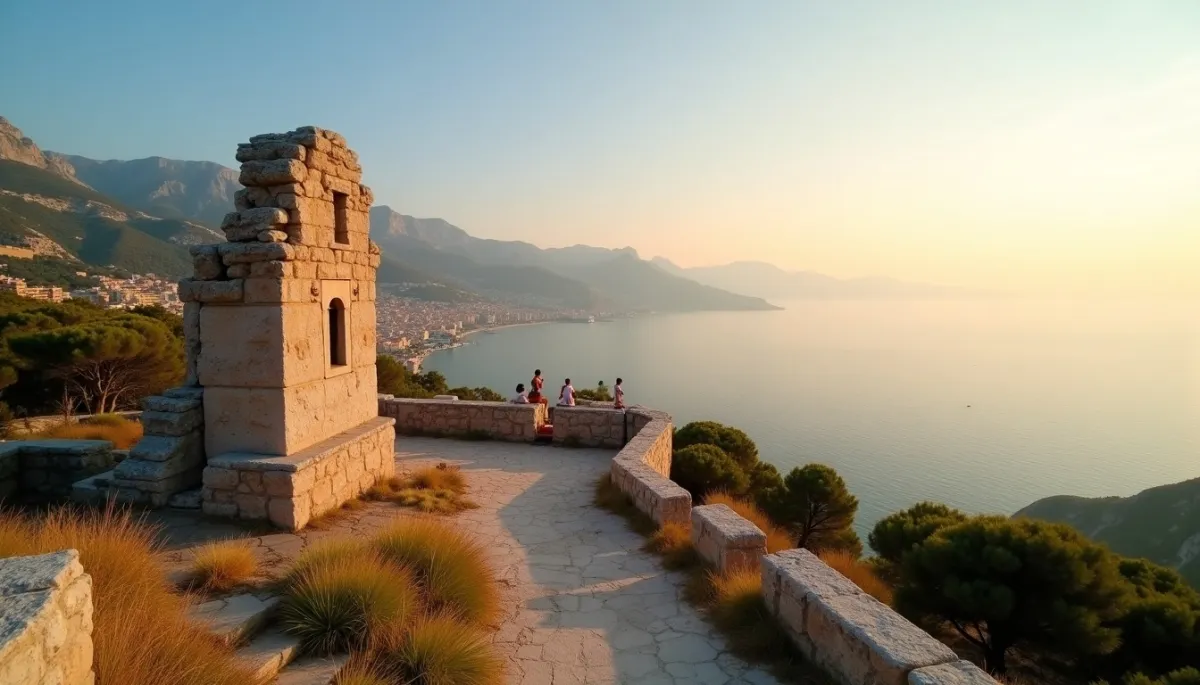
Today, the ruins are still impressive. From the terrace in front of the site, the view plunges down to Monaco and out to the Mediterranean, a panorama that explains why the Romans chose this exact promontory for their statement of power.
Histoire visible
The visible consequence of that Roman decision is multiple: an archaeological landmark, a tourist viewpoint, and a local identity anchor for La Turbie. The monument has shaped maps, roads and the very way people experience this stretch of coast for two millennia.
During the Middle Ages the Tropaeum was dismantled and stones were reused for fortifications and local construction, a common fate for many Roman structures. Later, travelers on the Grand Tour of the 18th and 19th centuries noted its ruins as a picturesque curiosity above Monaco.
In modern times, state-led restorations have stabilized the remains and turned the site into an accessible heritage attraction. Information panels and a small museum near the monument help visitors read the traces of inscription and sculptural fragments that survive.
Pourquoi ici
Why build such a trophy here? The answer mixes geography and politics. From La Turbie, one commands the maritime approaches and the coastal road. For Rome, marking control of mountain tribes and a major transit axis was both strategic and symbolic.
The monument commemorated the subjugation of roughly 45 Alpine tribes, an impressive list meant to legitimize Augustan rule across the western Alps. That inscription turned a stone edifice into a written record, an early example of power made durable by text and architecture.
Moreover, the site sits on the Via Julia Augusta, inaugurated under Augustus to improve connections across the region. Placing a triumphal monument beside that artery amplified its visibility to travelers, merchants and soldiers moving between Italy and Gaul.
Regard contemporain
However, this long story is not without contradictions. The monument celebrated conquest, but over centuries it became a quarry and a ruin, then an object of romantic curiosity, and finally a protected heritage site. Its meaning shifted with each era's priorities.
Today, conservation raises modern questions: how to balance visitor access, local life in La Turbie, and archaeological research. Seasonal crowds in summer can be heavy, yet careful management preserves the monument and its surroundings.
For visitors, the Tropaeum is an invitation. Walk the paths around the site, read the inscriptions reproduced on panels, and take the short detour into La Turbie's medieval lanes. From the viewpoint, Monaco's modern skyline and the curve of the bay offer a powerful contrast to the Roman message engraved in stone.
Practical tips: arrive early or at sunset for softer light, wear comfortable shoes for the uneven ground, and combine the visit with the village museum. From Monaco, the Moyenne Corniche offers a 10-minute drive; there are also marked hiking trails for walkers who prefer a slower approach.
Thanks for reading, and don't forget, Enjoy Life Moments!