From pro surfer to Trappist monk: the quest for waves and silence
🚀 Key Takeaways
- Key concept : Discipline and surrender connect surfing and Trappist life.
- Practical tip : Start with daily silence, short digital fasts, and simple rhythms (sleep, prayer, work).
- Did you know : The Trappist reform began in the 17th century under Armand de Rancé; Gethsemani Abbey in Kentucky hosted writer Thomas Merton in the 1940s.
He felt the sea in his bones.
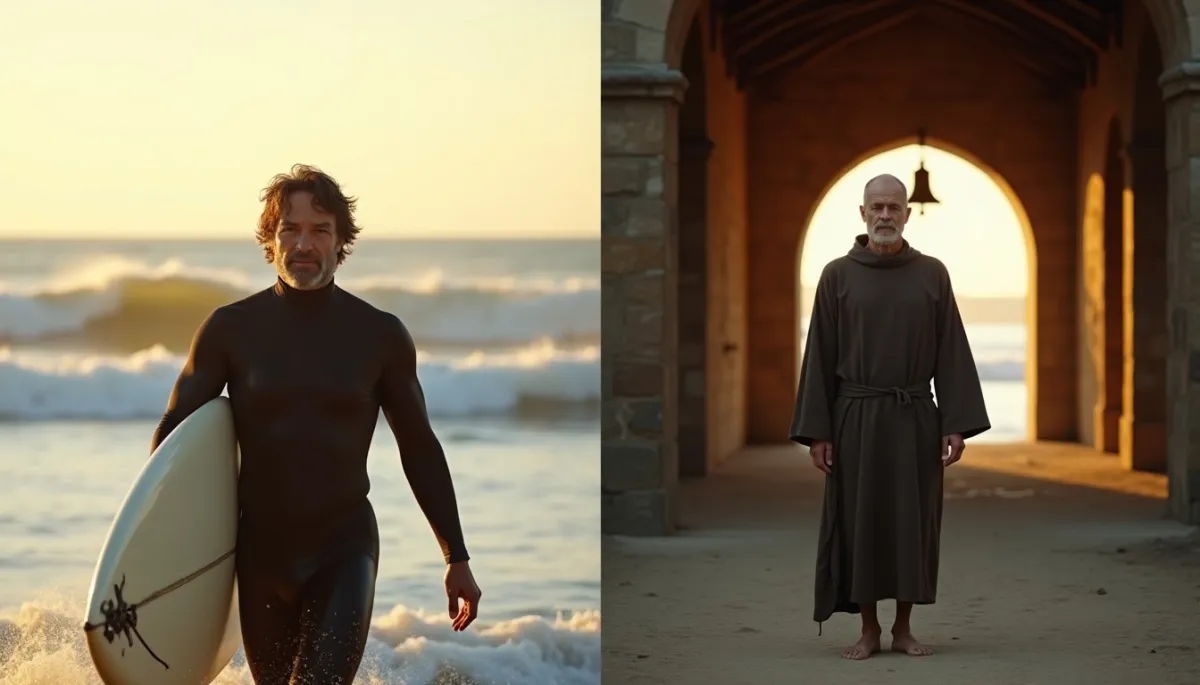
Picture an empty shore at first light, the sky a pale bruise, surfboard under one arm, wetsuit clingy like a second skin. Once he paddled out for heat after heat, under stadium lights and the noise of judges. Now he slips between stone cloisters to chant at Matins, and his early mornings are marked by the toll of a wooden bell. Yet the inward rhythm—waiting, reading the wave, accepting what comes—remains recognisable.
vagues et baptême
The protagonist of this story is a former professional surfer, member of the international circuit in the 2000s and early 2010s, who competed on famous breaks from Bells Beach in Australia to Hossegor in France, and rode the giants of Nazaré in Portugal after big wave culture exploded post-2011 with Garrett McNamara's landmark ride.
He grew up on a coastline where surfing is a language, starting with local contest wins in his late teens, then signing sponsors and touring. Pro surfing became a public life, televised heats, sponsors' dinners, and the calendar of the then ASP tour (the Association of Surfing Professionals, rebranded World Surf League in 2015).
His story echoes others from sport to solitude. Think of Thomas Merton, who left an early life of travel and literary ambition to enter the Abbey of Gethsemani in Kentucky in 1941, publishing The Seven Storey Mountain in 1948. Merton's path is different, yet his conversion shows how creative, adventurous personalities sometimes seek ordered silence to find depth.
du pro à l'ermite
Why would a surfer who tasted success switch to Trappist life? The answer is layered. There is the physical cost: injuries, concussions, the exhaustion of perpetual travel. There is the spiritual fatigue: the appetite for novelty blunted by repeated adrenaline and the thinness of sponsorship-driven meaning.
For our surfer, a series of events pushed the change. A near-miss during a big-wave session, a season cut short by a knee operation in 2013, and an episode of deep personal questioning after a close friend's overdose led him to step back. He tried meditation retreats in 2016, spent a month at a Benedictine guesthouse, then discovered Trappist monasteries on a reading list that included Merton and the Rule of Saint Benedict.
Trappists (the Order of Cistercians of the Strict Observance) are known for austerity: long hours of communal prayer (the opus Dei), manual work, and silence. The reform associated with La Trappe began in the 17th century under Armand Jean le Bouthillier de Rancé, and today Trappist abbeys are found worldwide, from Scourmont in Belgium to Gethsemani in Kentucky, each with a strong rhythm that attracts seekers.
silence retrouvé
Contradictions appear, and they are beautiful. Surfing is extroverted and elemental, trained in the public arena. Trappist life is introverted and ordered, practised within cloistered walls. Yet both demand repetition, patience, humility, and a body trained to read signals—wind, swell, stone, liturgy.
He describes the monastery as a different kind of ocean. There are currents—hours of prayer, shifts of manual labour, the community's unspoken rules. He learned to 'read' monastic rhythm the way he read sets on a lineup. The same muscles that memorised pop-shove-rotations now steady a scythe or kneel for Vigils.
For readers curious to try an element of this pilgrimage, start small. Try a digital fast for one morning, practice a single hour of silence, or volunteer for manual work (gardening, cooking) in a local retreat house. Read Merton's The Seven Storey Mountain (1948) and short practical guides to contemplative practice. If you are a surfer, notice how breath control and balance translate to sitting meditation.
There is no call to renounce the world for everyone. The story is less about permanent escape and more about reorientation. Some athletes return from cloisters to society with new projects: community surf schools, environmental advocacy, contemplative coaching for high-performance life. The boundary between wave and cloister can become a bridge.
In the end, a man who once chased the perfect barrel now listens for a different perfection: the toll of a bell, the cadence of psalmody, the plainness that makes ordinary sights holy. The absolute he sought in the charge of a wave he now seeks in the absolute of silence and shared work.
Thanks for reading, and don't forget, Enjoy Life Moments!