Philippe Petit, the tightrope artist who walked between the Twin Towers
🚀 Key Takeaways
- Key concept : Funambulism, the art of tightrope walking, meets guerrilla performance.
- Practical tip : Want to try slacklining? Start low, use a safety line, and build core strength gradually.
- Did you know : The 2008 documentary "Man on Wire" won the Academy Award for Best Documentary Feature.
He walked calmly, as if the air itself were a stage.
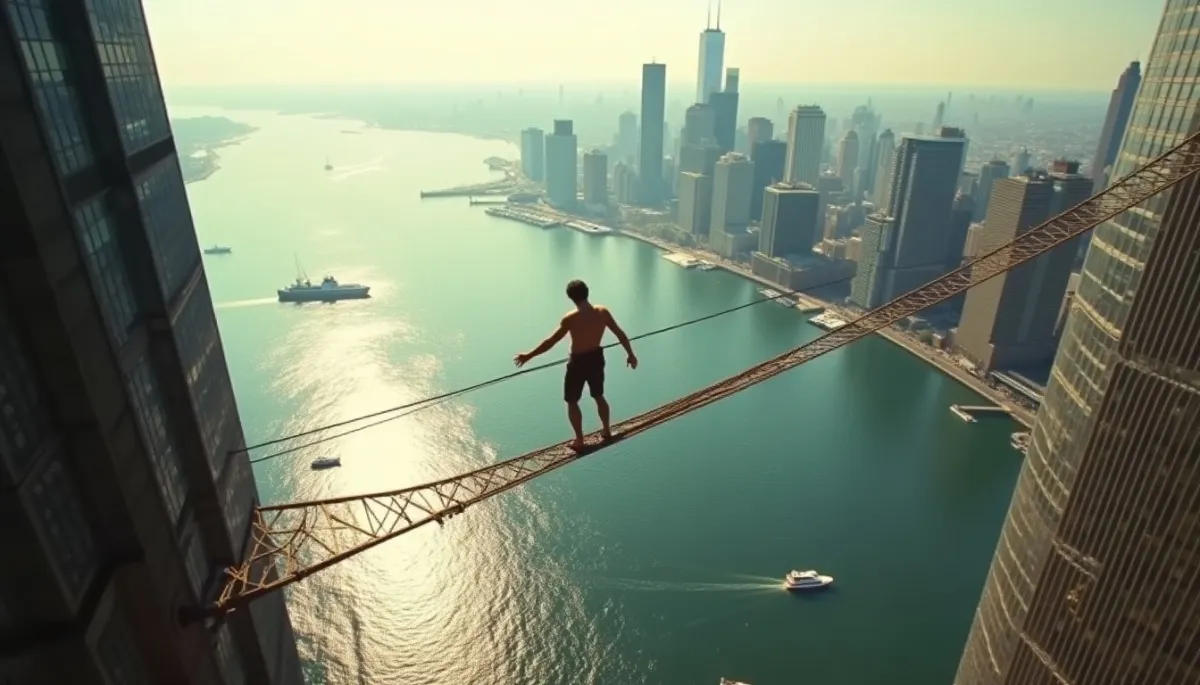
The scene was impossibly cinematic: two steel towers piercing the summer sky of Lower Manhattan, early-morning light, a thin cable stretched like a drawn breath between them. Below, New Yorkers were still waking. Above, Philippe Petit moved, step by deliberate step, barefoot, arms outstretched, making eight crossings over roughly 45 minutes. Spectators on rooftops and in boats craned their necks. The city held its breath.
an unforgettable feat
Philippe Petit, born August 13, 1949 in Nemours, France, built a career at the boundary of circus, art, and provocation. He had already stunned Paris in 1971 when he walked on a wire between the towers of Notre-Dame cathedral. That act announced his appetite for spectacular, illegal performances that blurred the line between crime and poetry.
The World Trade Center walk took place on August 7, 1974. The towers, designed by Minoru Yamasaki and completed in 1973, were among the tallest buildings in the world. Petit rigged a 200-foot steel cable between the towers, approximately 1,350 feet above the ground. He made several crossings, performed tricks, even kneeled to pray at the midpoint. The episode cemented his image as the quintessential 'man on wire.'
The event was immortalized in the 2008 documentary Man on Wire, directed by James Marsh, which won the Academy Award for Best Documentary Feature in 2009. Petit later wrote books and gave talks, including a 2009 TED talk that further explained his philosophy: art as daring, and precision as a form of poetry.
how he did it
The walk was not spontaneous. Petit and a small, loyal team spent months planning logistics, reconnaissance, and the clandestine transportation of gear. They rehearsed rigging techniques, timed their moves, and studied the guards' patrols. The technical core was simple, yet exacting: a steel cable anchored to the towers, tensioned with a winch, and a balancing pole that Petit used to modulate his center of gravity.
A famous anecdote about the preparation: the crew reportedly used a bow and arrow to send a light fishing line across the gap as an initial step to pull heavier ropes. Small acts of improvised engineering like this turned impossible into manageable. The entire operation resembled a theatrical heist, mixing ingenuity, risk, and secrecy.
When security discovered him he was arrested. He spent a short time in custody. The legal consequences were minor; the authorities treated the episode less as a felony and more as a bizarre stunt. Municipal responses shifted with time: what began as trespass became part of cultural memory, and Petit later received invitations to perform legally and to speak about his work.
shadow and light
The Twin Towers walk sits uneasily in history. On one hand it is celebrated as an act of artistic audacity, a moment when a single human body redefined the skyline. On the other hand, after September 11, 2001, the towers acquired new meanings. Petit himself addressed this complexity with humility. He never sought to glorify danger; his persistent theme is attention, the practice of presence that transforms risk into art.
Petit remained an educator of balance. He used the word funambulism to describe what many call tightrope walking. Funambulism comes from Latin roots: funis, rope, and ambulare, to walk. He emphasized practice, respect for equipment, and the ethics of performance. For Petit, the wire was a site of communion, not conquest.
For readers inspired by his story, start small. Slacklining is a modern, accessible cousin of high-wire art. Use certified anchors, work with an experienced instructor, and progress step by step. Balance is learned through repetition, breath control, and core strengthening. Above all, honor safety so daring can become discovery.
Philippe Petit's walk between the Twin Towers remains a vivid lesson: art can change the way we see public spaces, and courage can be expressed as creativity. The image of a man walking between two towers continues to travel across generations, prompting the question: what would you balance your life upon?
Thanks for reading, and don't forget, Enjoy Life Moments!