Monaco's sea extension: building an eco-district on water
🚀 Key Takeaways
- Key concept : A maritime eco-district blends reclaimed land or floating platforms with habitat restoration and low-carbon design.
- Practical tip : Prioritize breakwaters that double as reefs, solar canopies, and modular platforms for adaptability.
- Did you know : Monaco has under 2.1 km² of land and nearly 40,000 residents, which explains the recurring push to extend into the sea.
Imagine stepping off a tram into salt air and lavender, with the old rock of the Rock of Monaco behind you and a new quay alive with terraces and seagrass ahead.
une mer gagnée
The Principality has already reshaped its coastline. Fontvieille, the district created on reclaimed land during the late 20th century, remains the most concrete example of winning land at sea in Monaco's history.
Today, with less than 2.1 square kilometres of territory and around 40,000 inhabitants, Monaco faces severe spatial constraints. Expanding on the water is not a novelty, it is a strategic necessity to host housing, public spaces and climate-resilient infrastructure.
Reclaimed land provides continuity with the existing urban fabric, enabling roads, utilities and services to extend naturally. Yet traditional reclamation can damage seabeds and marine life unless it is rethought from the start.
racines et raisons
Why are we talking about sea extensions now? Urban pressure, tourism demand and climate risks converge. Rising real estate prices inland push planners to seek alternatives, while hotter summers and more intense storms make shoreline design urgent.
There is also a cultural and political momentum. Since 2006, Prince Albert II's Foundation has amplified Monaco's environmental commitments. Combining prestige, limited territory and philanthropic will makes bold experiments possible here more easily than elsewhere.
Technically, today's options are richer than when Fontvieille was built. Engineers can choose between landfill protected by modern breakwaters, or floating platforms engineered to absorb sea level changes. Dutch firms like Waterstudio and the Rotterdam Floating Pavilion (2015) have shown how floating communities and public pavilions can integrate urban life with water stewardship.
réinventer la mer
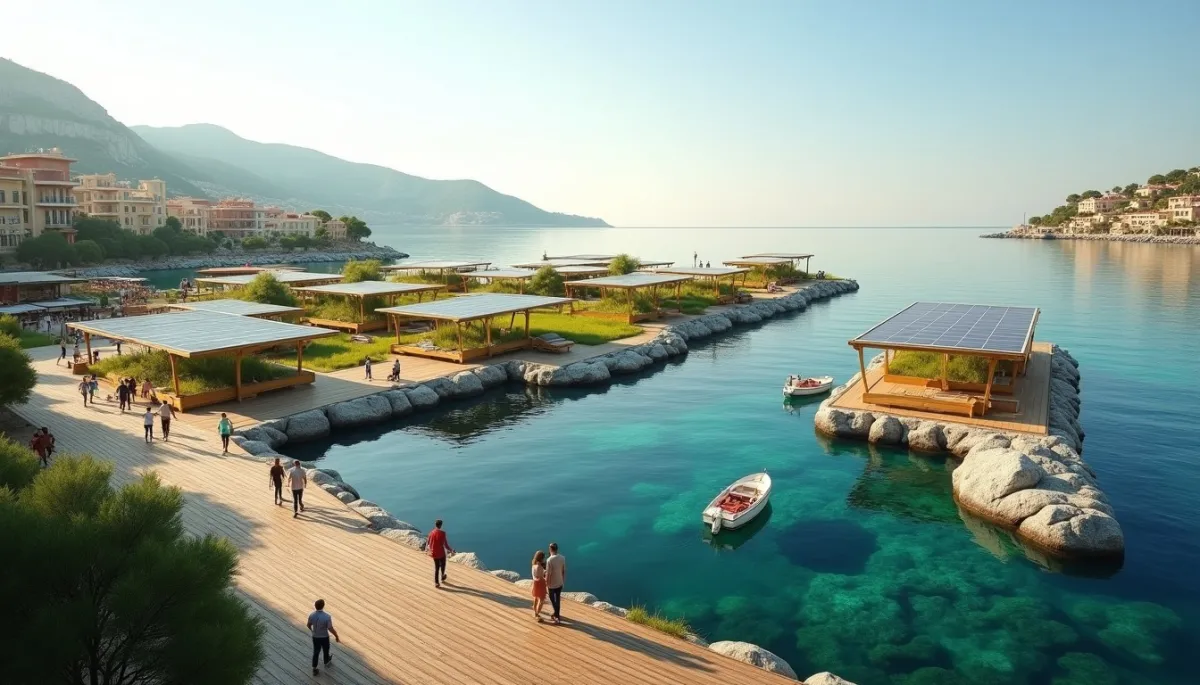
Designing an eco-quartier on the water means three priorities: protect and restore biodiversity, minimize carbon and energy footprints, and ensure social diversity. That translates into concrete measures.
First, build hybrid coasts: breakwaters designed as artificial reefs, retaining walls with textured surfaces for mussels and seaweeds, and shallow lagoons for seagrass meadows. These features increase coastal resilience and local fisheries productivity.
Second, opt for low-carbon materials and systems. Marine-grade concrete with recycled aggregates, modular steel pontoons that can be replaced, on-board geothermal or heat-pump systems, and photovoltaic canopies on quays reduce lifetime emissions. Water recycling, local desalination with renewable energy and rooftop gardens close resource loops.
contraintes et compromis
Ambition collides with regulation and ecology. Any large-scale extension requires international maritime discussion, and cooperation with France on territorial and environmental matters. Environmental impact studies must be exhaustive and public, including baseline surveys of benthic habitats and sediment dynamics.
Cost is another reality. Building on water is capital-intensive. Phasing a project, starting with pilot floating platforms for cultural or commercial use, helps test concepts while spreading investment. Monaco could use pilot modules as living labs, open to researchers and citizens.
Finally, social considerations must remain central. An eco-quartier should not be an elite enclave. Mixing affordable housing, public parks, schools and maritime cultural spaces will make the project durable and genuinely resilient.
Thanks for reading, and don't forget, Enjoy Life Moments!