How the Maya calendar really worked
🚀 Key Takeaways
- Core concept : Three calendars worked together: a 260-day ritual (Tzolk'in), a 365-day civil year (Haab') and the Long Count for historical dates.
- Practical tip : Visit Chichén Itzá or Copán at sunrise to feel how architecture and calendar align.
- Did you know : The Dresden Codex records Venus and eclipse tables, showing advanced Maya astronomy.
It feels like listening to a clock built by stargazers.
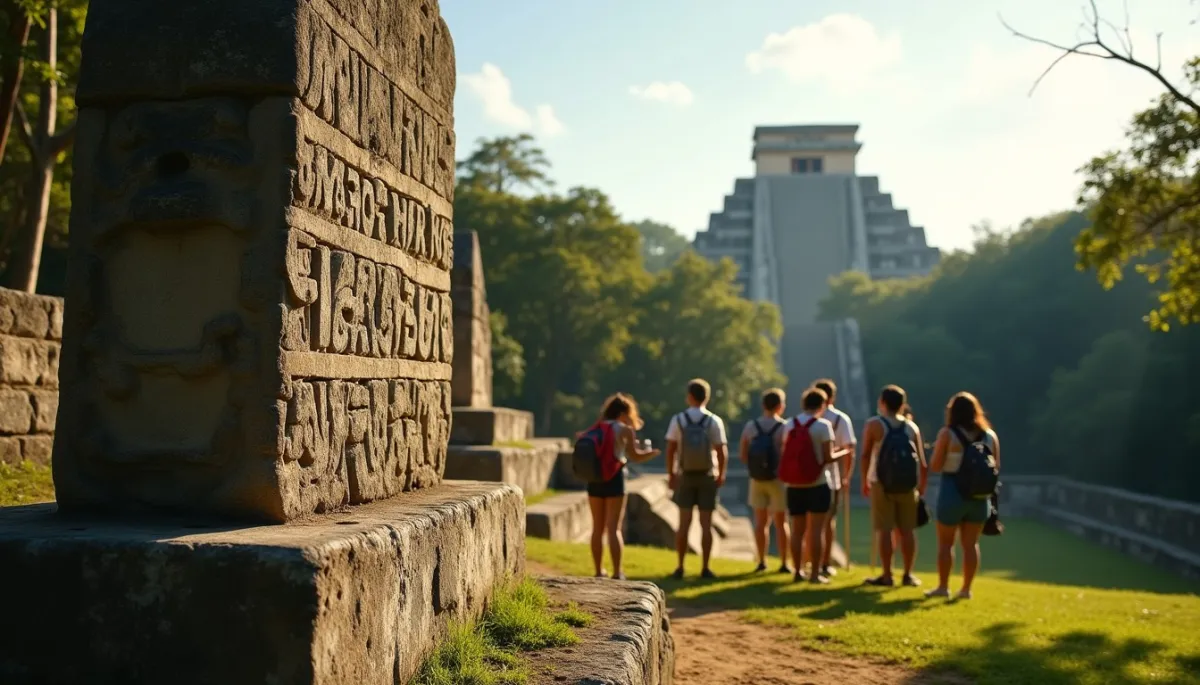
Imagine standing before a carved stela at Copán or Quiriguá, late morning light picking out glyphs that record a date in a numeric code. Local guides point to a series of dots and bars; those signs are not decorative, they are numbers, and the inscription ties that moment to celestial cycles observed for centuries.
measures du temps
The Maya used several overlapping systems to measure days. The Tzolk'in is a 260-day cycle combining 20 day names with a rotating count from 1 to 13. It served ritual, divinatory and scheduling purposes.
Parallel to the Tzolk'in, the Haab' was a 365-day civil year. It had 18 months of 20 days plus a short 5-day period called Wayeb (considered unlucky). The Haab' is not leap-adjusted; the Maya accepted a drifting solar year for administrative rhythm.
For long historical spans they used the Long Count. This is a linear count of days since a mythical starting point. Units include kin (1 day), uinal (20 days), tun (360 days), katun (7,200 days) and baktun (144,000 days). When you see a date like 13.0.0.0.0, you are reading baktuns, katuns, tuns, uinals and kins.
étoiles et pouvoir
Timekeeping was inseparable from astronomy. The Dresden Codex, probably compiled between 1200 and 1400 CE, contains precise Venus tables and eclipse records. Observations of Venus (synodic period 584 days) guided warfare and ritual timing.
Monuments at observatories such as the Caracol at Chichén Itzá show alignments with solstices and planetary risings. Priests and astronomer-priests used horizon sightings and architectural alignments rather than telescopes, yet their accuracy over decades is impressive.
Spanish accounts from the 16th century, notably by Bishop Diego de Landa (Relación de las cosas de Yucatán, 1566), preserved fragments of calendar knowledge while also catastrophically destroying many books around 1562. Only a few codices survive: Dresden, Madrid, Paris and the contested Grolier fragment.
pierre, mythe et réalité
Long Count dates carved on stelae across the Maya region anchor history. The correlation most scholars use (Goodman-Martínez-Thompson, called GMT) links Long Count day zero to 11 August 3114 BCE (proleptic Gregorian). This gives modern calendar equivalents to ancient inscriptions.
The 21 December 2012 date, widely publicized as 13.0.0.0.0, sparked doomsday theories. In fact, for the Maya it marked a cycle reset, similar to a millennium celebration. Inscriptions like Tortuguero Monument 6 mention that period, but they do not predict an apocalypse.
Today, renewed interest in Maya calendars comes from both scholars and Maya communities. Researchers use epigraphy, archaeology and astronomy to refine correlations and decode glyphs. Local Maya groups revive ceremonial uses of the Tzolk'in, while museums display facsimiles of codices so visitors can appreciate the scientific depth of ancient observations.
conseils et curiosités
If you want to explore the calendar on site, begin at early light. Chichén Itzá's eclipse and equinox phenomena, the stelae of Copán, and the Dresden Codex facsimile in Germany are complementary experiences. Ask certified local guides about dates carved on monuments.
Understand simple terms: Tzolk'in (260-day ritual cycle), Haab' (365-day year), Long Count (continuous count from 3114 BCE). Tun is roughly a year (360 days in Maya notation), katun about 20 tuns, baktun about 400 tuns.
Respect living traditions. Some rituals remain sacred. Photography may be restricted in certain ceremonies. Learning a few words from contemporary Maya guides enriches the visit and supports cultural continuity.
Thanks for reading, and don't forget, Enjoy Life Moments!