Marina Abramović and Ulay: extreme art and the moving meeting on the Great Wall of China
🚀 Key Takeaways
- Key concept : A 1988 durational performance where two artists walked the Great Wall from opposite ends and met in the middle, ending their personal and artistic relationship.
- Practical tip : Visit sections of the Great Wall like Mutianyu or Jinshanling to sense scale, and try a slow, silent walk with a companion to experience presence.
- Did you know : They reunited unexpectedly during Marina's 2010 MoMA performance "The Artist Is Present", creating one of modern art's most viral moments.
Two figures on an ancient stone spine, walking toward the other until there is no way back.
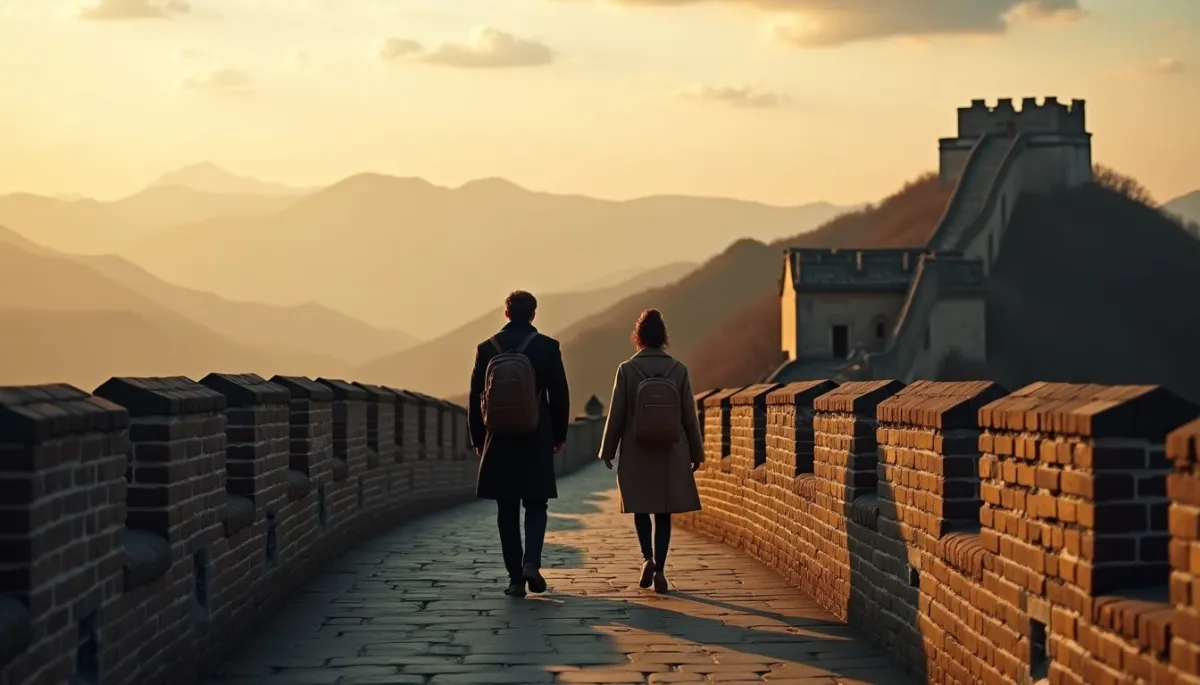
Imagine cold wind sweeping across crenellations, tourists in bright jackets at distant viewpoints, and two exhausted artists tracing footsteps left by centuries of travelers. On sections of the Great Wall you can still feel the rhythm of their walk: one coming from the east, the other from the west, each step measured, each day an act of letting go. That walk, in 1988, was as much an artwork as a ritual of separation.
Rencontres et rituels
Marina Abramović, born in Belgrade, and Ulay, a German artist, began a professional and romantic partnership in the 1970s. They became known for performance pieces that tested physical limits and explored trust, presence, and the body as medium.
Works like Imponderabilia (1977), where they stood naked in a narrow gallery door forcing visitors to navigate between their bodies, made headlines. Rest Energy (1980) at MoMA intensified their themes: Ulay held a taut bow pointed at Marina's heart while she supported the arrow's tension. These pieces established them as pioneers of endurance and relational performance.
The Great Wall project, often called The Lovers or The Great Wall Walk, was conceived as a durational, participatory act. In 1988 they decided to walk toward each other from opposite ends and meet in the middle, turning a geographic gesture into a symbolic conclusion.
Marche et choix
The choice to use the Great Wall was deliberate. The wall is a structure of continuity and division, built over centuries to mark boundaries and protect. For Marina and Ulay it became a theater of extremes: distance as narrative, steps as sentences.
They walked for some 90 days, each alone on long stretches, carrying what they needed, confronting weather and terrain. The act was far from a staged photo opportunity. It was an austerely choreographed end, a mutual decision to close both life and collaboration with an embodied statement.
The meeting in the middle was quiet. They embraced briefly, and then parted. The image of two artists arriving exhausted, then choosing silence over spectacle, remains a powerful lesson in artistic closure and in how performance can transform personal ritual into collective myth.
À distance et retour
After 1988 their joint work ended, but their influence grew. Their performances are studied in art schools, exhibited in archives, and debated by critics. They shifted ideas about what art can do: provoke, heal, wound, and document intimacy.
Years later, in 2010, Marina staged The Artist Is Present at MoMA in New York. During that durational sitting, Ulay unexpectedly appeared and took the chair across from her. The reunion, silent and intense, went viral. For many viewers it closed a loop between past performances and present memory.
Ulay's death in March 2020 added another layer to the story. The Great Wall walk, the early risky performances, and the unexpected reunion now read as chapters of a single, dramatic narrative about love, endurance, and art's ability to record human choices.
For the traveler, there are simple takeaways. Walk slowly. Notice the body in space, the weather, the presence of another person. Try a silent stretch on a long wall or path, and see what emerges when the ordinary becomes a shared ritual.
Thanks for reading, and don't forget, Enjoy Life Moments!