Kitesurf in Isla Blanca: the best kept secret of wind lovers
🚀 Key Takeaways
- Key concept : Isla Blanca is a shallow coastal spit offering consistent trade winds and flat-water sections ideal for kitesurfing.
- Practical tip : Best winds run from November to May, arrive early to avoid crowds and respect local ecology.
- Did you know : Located about 20 km north of Cancún, the area pairs mangroves and lagoons that require low-impact tourism.
Wind fills the sails and the lagoon turns into a silver mirror.
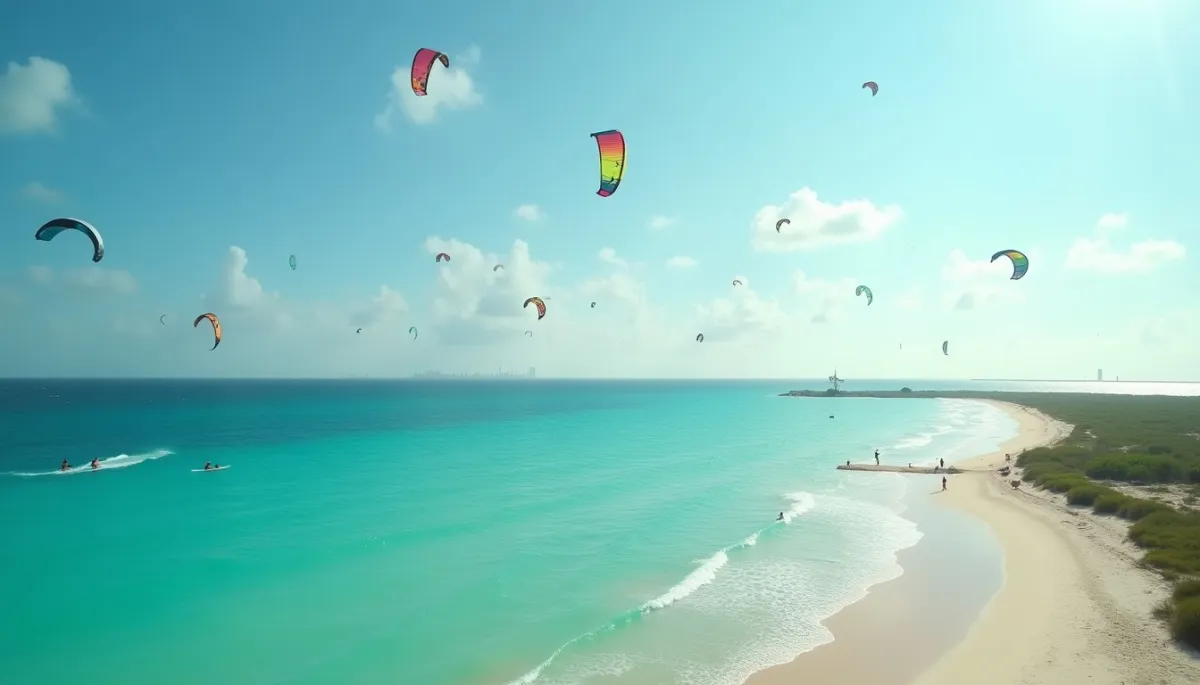
Picture stepping out of your van at dawn, turquoise water stretching to the horizon, milky sand underfoot, and dozens of colorful kites dotting the sky. In the distance, the skyline of Cancún is a faint silhouette. Local instructors carry boards and sailors unfurl kites, while pelicans wheel above the mangroves. The scene feels both remote and accessible, an island that belongs to the wind.
lagune des vents
Isla Blanca is a narrow sandbar that sits just north of Cancún, in the municipality of Isla Mujeres, Quintana Roo. Its proximity makes it reachable in 30 to 45 minutes from downtown Cancún, via the road toward Punta Sam and then a dirt track. The spot is famous among kiters because the lagoon is shallow, often waist to chest deep, which creates flat water perfect for learning and freestyle.
The trade winds that sweep the area come from the east-northeast, and are most reliable during the dry season. Locals and instructors consistently report steady winds from November through May, with particularly strong, stable conditions in March and April. These predictable winds are a magnet for riders from Mexico and abroad, especially from late fall to spring.
Since the early 2000s, Isla Blanca has grown a reputation as a low-key alternative to more crowded spots like Playa del Carmen or Tulum. Early adopters were kiters who prized shallow reefs and room to jump, and over the last decade small schools and rental shacks have established a welcoming, community-driven scene.
raisons du succès
Beyond the wind, the geography explains the appeal. The lagoon's bathymetry (depth profile) gives a mix of sandy flats and channels, which create both flat water and small ramps for jump practice. For beginners, instructors can set up lessons in waist-deep water where a student can stand and recover easily.
Another factor is accessibility. Cancún's international airport, with over 20 million passengers annually in recent pre-pandemic years, brings kiters to the region with relative ease. From there, a short transfer puts riders at the lagoon without the long drives often required elsewhere in Mexico.
Stories circulate among the community. One instructor, Diego, started teaching in 2007 after a trip to Brazil. He opened a small school with three boards and a handful of kites. Today he runs safety courses and has helped organize friendly competitions that keep the scene informal but structured. Such grassroots growth has shaped Isla Blanca's authentic vibe.
précautions et avenir
Popularity brings responsibility. The lagoon and its surrounding mangroves are ecologically sensitive. Conservation organizations and local councils have, since the 2010s, promoted low-impact practices. Visitors are asked to avoid trampling mangroves, to use marked access points, and to carry out any waste.
Safety remains a practical concern. Offshore winds can develop on rare days, and tides change channels quickly. Always check local forecasts, ask a local instructor about wind direction, and never kite alone. Equipment rentals and certified instructors are widely available; lessons that include rescue procedures cost a bit more but are worth it.
Looking forward, balancing growth and protection is the key. Small initiatives, such as community cleanups and limits on new permanent infrastructure, aim to preserve the spot's character. For travelers, the advice is simple: come curious, learn locally, and leave the place better than you found it.
Thanks for reading, and don't forget, Enjoy Life Moments!