Frida Kahlo's incredible destiny: turning pain into eternal art
🚀 Key Takeaways
- Concept key : Frida made her body and pain the subject of modern art.
- Practical tip : Visit La Casa Azul in Coyoacán to feel her atmosphere, and try a brief sketch to understand self-portraiture.
- Did you know : She survived polio and a near-fatal bus crash in 1925, events that shaped her iconography.
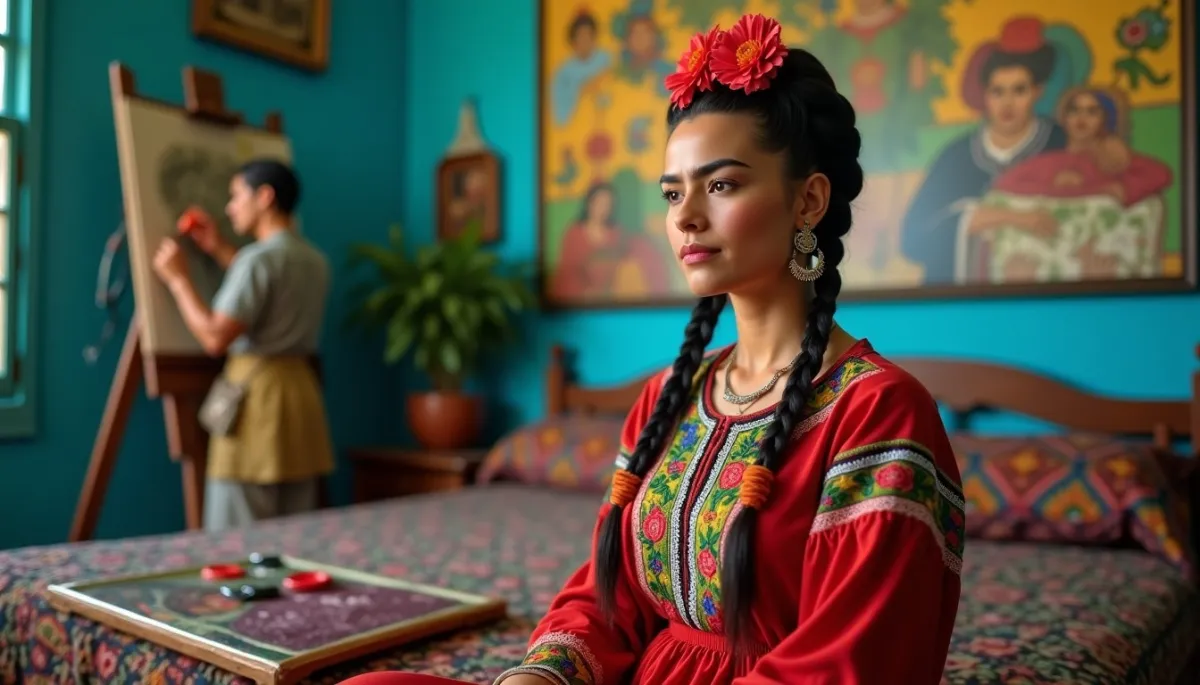
She painted herself to survive. Imagine a small blue house in Coyoacán, 1930s sunlight through paper flowers, a wheeled easel and a mirror fixed above a bed.
Faces that remain
Frida Kahlo, born Magdalena Carmen Frida Kahlo y Calderón on 6 July 1907, is above all known for her self-portraits. Works such as The Two Fridas (1939), Henry Ford Hospital (1932), and Self-Portrait with Thorn Necklace and Hummingbird (1940) placed her image at the centre of modern art.
Her oeuvre is compact but intense, a handful of paintings that mix Mexican popular imagery, anatomical realism, and symbolic detail. Museums and collectors now seek her work worldwide, and exhibitions at places like the Julien Levy Gallery in New York in 1938 helped install her reputation internationally.
She is also inseparable from La Casa Azul, the bright home in Coyoacán where she was born, lived and died. Opened to the public as the Frida Kahlo Museum in 1958, it preserves dresses, corsets, letters and the peculiar intimacy of her world.
Wounds that speak
Frida's biography explains much of her iconography. At six, she caught polio, leaving her right leg thinner. On 17 September 1925, at eighteen, she survived a horrific bus-tram collision in Mexico City. A steel handrail impaled her pelvis, fractures multiplied, and doctors told her she might never have children.
Confined to bed for months, she painted with a mirror suspended above her. This practical setup explains why so many of her works are self-portraits. She underwent more than 30 operations during her life, wearing metal corsets and plaster supports, facts that manifest in her images of broken spines, pierced bodies and surgical scenes.
Her marriage to Diego Rivera in 1929 was another defining element. Rivera, twenty years her senior and already a famous muralist, opened doors, but their relationship was tempestuous. They divorced in 1939, remarried in 1940, and their love and betrayals appear in Frida's art as tenderness and torment.
Roots and colors
Frida located herself in a deliberate Mexican identity, a concept often called mexicanidad. She collected indigenous clothing, wore braided hair with ribbons, and used pre-Columbian symbols. This aesthetic was also political: in the 1930s and 1940s she lived during a national revaluation of Mexican heritage after the Revolution (1910-1920).
Although André Breton and the Surrealists in Paris labelled her work 'surrealist' in the late 1930s, Frida rejected the label. She famously said, 'I never painted dreams. I painted my own reality.' Surrealism (an artistic movement focusing on the unconscious and dream imagery) thus meets in her paintings with stark autobiography and pain.
Her travels to the United States in the 1930s, exhibitions in New York and interactions with leftist intellectuals, including hosting Leon Trotsky at La Casa Azul in 1937-1939, expanded her political and cultural network, without diluting the intensely personal tone of her art.
Contradictions and legacy
Frida's life was full of contradictions. She produced intimate self-portraits while earning public fame, she celebrated life and color while chronicling suffering, and she embraced Mexican folk art while engaging with international modernism.
After her death on 13 July 1954, the rhythms of recognition were slow. Only decades later, from the 1970s and especially the 1980s onward, did a global reassessment take place. Feminist movements embraced her as a symbol of female creativity and endurance. Today her image has become iconic, used on everything from postage stamps to fashion, sometimes provoking debates about commodification of a complex life.
For visitors and creators, Frida offers concrete lessons. Start with close observation: look at a painting for ten minutes, note objects, colors, and wounds as signs. Try a short self-portrait exercise, using a small mirror and a limited palette, to understand how identity and image interact.
Her legacy also teaches resilience. Turning trauma into art is not a prescription, it is an example: pain can become language, and language can be shared. Frida transformed medical reports, love letters, and domestic objects into a visual autobiography that continues to speak.
Frida Kahlo is more than a biographical subject. She is a demonstration that art can be a way to translate the body, to make private suffering public and to create beauty from fracture. Her colors remain electric, her honesty still disarming.
Thanks for reading, and don't forget, Enjoy Life Moments!