From Madame Grès to Alaïa: the sculptural art of draping in haute couture
🚀 Key Takeaways
- Key concept : Draping is the technique of shaping fabric directly on a dress form, creating sculptural silhouettes.
- Practical tip : Start with a rectangular piece of heavy silk or crepe and pin it to a mannequin to learn the language of folds.
- Did you know : Madame Grès (1903-1993) and Azzedine Alaïa (1940-2017) shared an obsession: the body as a three-dimensional canvas.
It feels like rediscovering marble, only softer.
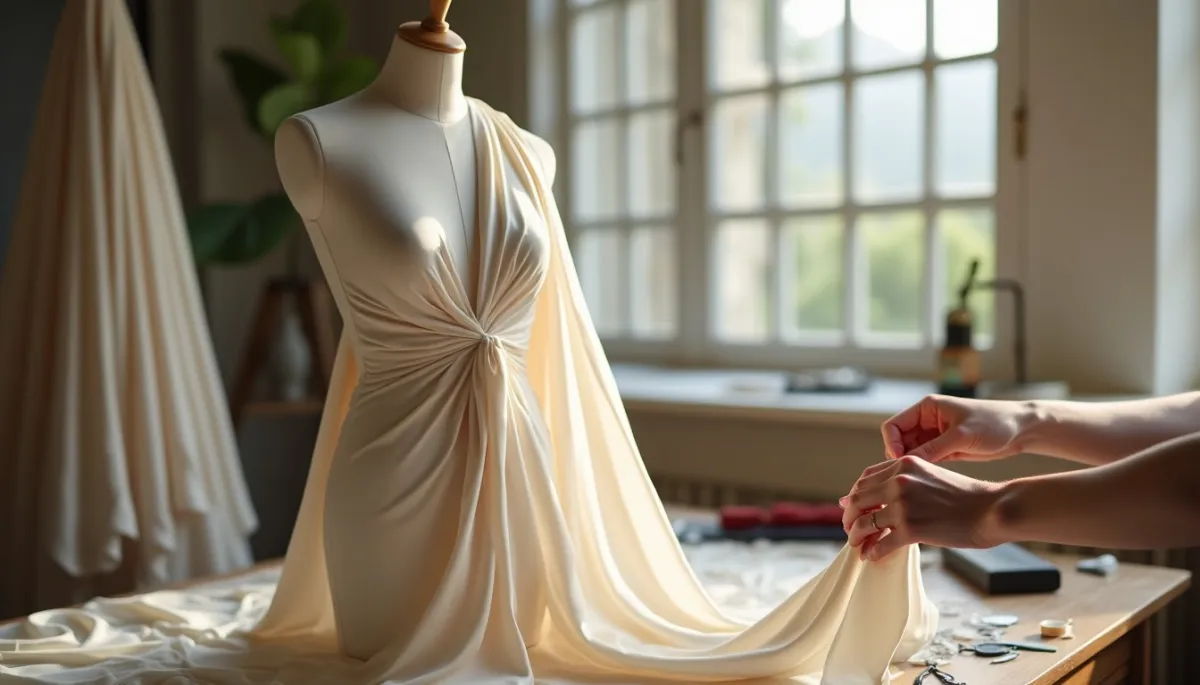
Imagine a quiet Parisian atelier, late afternoon light filtering through tall windows, a headless mannequin draped in silk that cascades like water. Hands, steady and patient, coax a pleat into place, then secure it with a pin. Nearby, bolts of crepe and jersey lean against a worktable, and the air smells faintly of starch and coffee. This is where architecture meets skin.
Folds that speak
Draping is at once technique and language. It lets a designer build directly in three dimensions, responding to weight, fall and gravity. Madame Grès mastered an almost archaeological patience, coaxing silk into Grecian gowns that read as columns, folds and negative spaces. Her work evokes antiquity, but with a modern exactness.
Alaïa approached fabric differently, yet with equal reverence. He treated the body as a sculptural volume, often cutting and assembling on the stand to achieve clinging silhouettes that celebrated form. Where Grès created statuesque drape, Alaïa revealed musculature and movement, frequently using stretch fabrics and leather to mold the body.
These two paths illustrate a spectrum: from drape that creates space around the body, to construction that sculpts the body itself. In both cases, the result is textile sculpture, a phrase that captures the ambition to make fabric become form.
Why it matters now
The renewed fascination for artisanal draping comes at a moment when fashion seeks authenticity and craft. Couture houses and independent designers are revisiting manual techniques that machines cannot fully replicate, and clients are more curious about the time and skill behind a garment.
Exhibitions and editorial features have helped too, making names like Madame Grès and Alaïa legible beyond the industry. Their work is taught in fashion schools, influencing a generation that values tactile processes. Moreover, social media has amplified close-up views of fabric, pleats and seams, turning technique into spectacle.
There is also a sustainability angle. Draping, when done with attention, reduces waste because designers manipulate the whole cloth, learning how to use every inch. The slow, considered approach aligns with a demand for pieces meant to last, both materially and stylistically.
Between reverence and reinvention
Yet tensions remain. Couture draping is time consuming, expensive, and hard to scale. The very qualities that make Grès' gowns and Alaïa's constructions revered also limit their commercial transfer to ready-to-wear. Many brands find it hard to reconcile artisanal labor with modern production schedules.
Technology is part of the response. Digital 3D draping tools simulate folds on virtual bodies, and laser cutting can reproduce intricate patterns. But these tools rarely capture the intuitive negotiation with fabric that a seasoned couturier performs. The future will likely be hybrid, combining hand skill with smart tools to retain emotion while improving efficiency.
For collectors and lovers of fashion, the lesson is simple. Observe the grain, the way light moves across a fold, the tiny hand-sewn stitches that hold a sculptural drape in place. Those are the details that separate a garment from a garment that feels like a small statue, made to be worn.
Thanks for reading, and don't forget, Enjoy Life Moments!