Calakmul: the ancient Maya megacity swallowed by the biosphere
🚀 Key Takeaways
- Key concept: Calakmul was a major Classic Maya capital, now protected within a vast biosphere reserve.
- Practical tip: Base yourself in Xpujil, arrive at dawn, bring water and insect repellent, and hire a local guide.
- Did you know: Inscribed as a UNESCO World Heritage site in 2002 for both its archaeological richness and the tropical forest that shelters it.
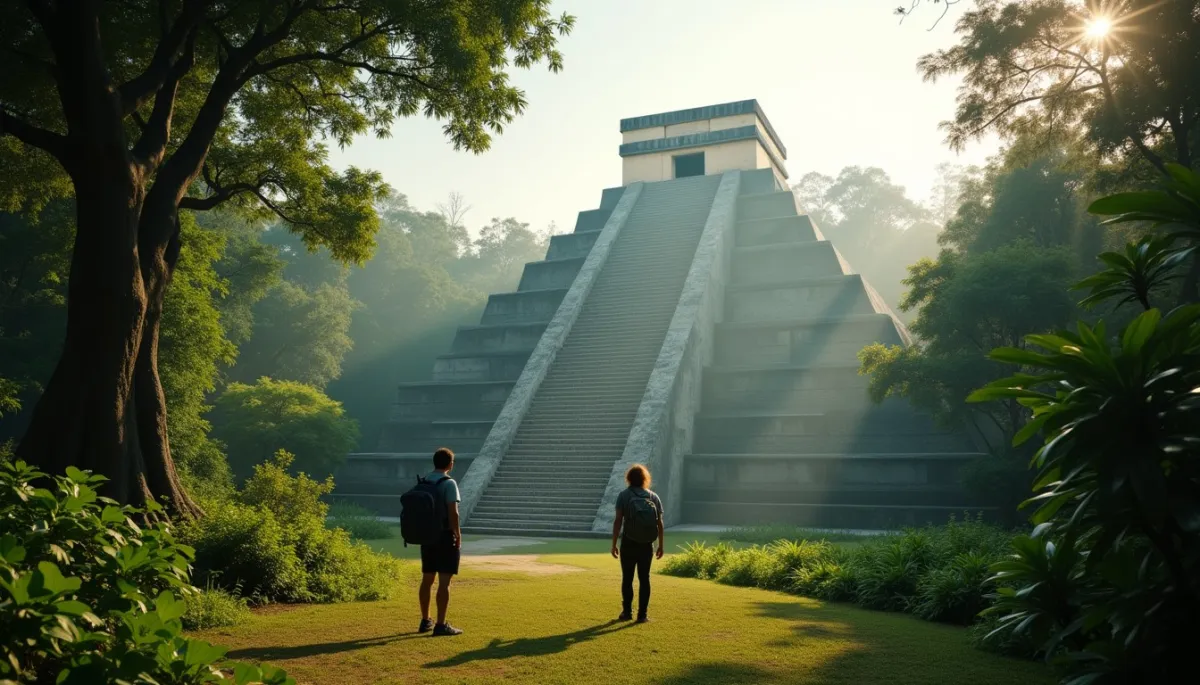
Silence thick as humidity. Imagine climbing an ancient pyramid, the canopy stretching to the horizon, and hearing only birds and the distant call of howler monkeys.
City swallowed
Calakmul was one of the largest and most powerful Maya cities during the Classic period (roughly 250–900 CE). Archaeologists uncovered thousands of structures hidden under the forest, from towering pyramids to ballcourts and monumental stelae decorated with hieroglyphs.
The site lies in the Mexican state of Campeche, deep inside what is now the Calakmul Biosphere Reserve. The relationship between ruins and jungle is intimate: trees have stabilized architecture, while old stones shape modern animal pathways.
Visitors who reach the summit of Calakmul's principal pyramids are rewarded with a near-cinematic view, a green ocean punctuated by temple roofs. That panorama explains why the site is often described as a city swallowed by the biosphere.
Power and politics
At its height, Calakmul was a political and military heavyweight. Epigraphic evidence connects the site to the so-called Snake dynasty (Kaan), a polity that engaged in long rivalries and shifting alliances, most famously with Tikal, farther north in today's Guatemala.
These rivalries shaped the Classic Maya world. Stelae and inscriptions record dynastic marriages, wars, and the installation of client rulers across the region. Calakmul's capacity to influence distant sites is one reason archaeologists call it a megacity in pre-Hispanic terms.
Although much of Calakmul was abandoned by the end of the Terminal Classic (around the 9th century), woodlands reclaimed the plazas and causeways, preserving them under layers of leaf litter and soil for centuries.
Forest guardians
The modern story of Calakmul is also a conservation story. In 2002 UNESCO inscribed "Ancient Maya City and Protected Tropical Forests of Calakmul, Campeche" on the World Heritage List, recognizing both cultural and natural values.
The biosphere supports jaguars, pumas, tapirs, spider monkeys and hundreds of bird species. Conservationists and local communities work to keep corridors open across the greater Maya Forest, connecting Calakmul to reserves in Guatemala and Belize.
That integration of culture and nature is rare and fragile. Protection measures balance archaeology, tourism and the livelihoods of rural families who live on the reserve's edges.
How the jungle saved it
One paradox of Calakmul is that the same forest that now makes access slow is the reason so much of the city survives. Roots and leaf-mold insulated stonework from centuries of direct looting, while the remoteness discouraged colonial and early modern exploitation.
Modern archaeology uses careful clearing, mapping and non-invasive techniques to study the site. Recent decades have also seen the use of remote sensing and LiDAR in neighboring regions, revealing how dense settlement once threaded the forest.
Today, archaeologists and conservationists collaborate closely. Studies of palynology (pollen), soil chemistry and tree rings help reconstruct ancient land use and how Maya agriculture shaped, and was shaped by, the forest.
Practical notes
To visit: the town of Xpujil is the usual base. From there, expect a bumpy drive along sandy roads into the reserve. Arrive early to avoid heat and to catch wildlife activity.
Bring at least two liters of water, sun protection, sturdy shoes and insect repellent. Hiring a certified local guide enriches the experience: guides read hieroglyphic motifs, explain architectural phases, and point out animal tracks and medicinal plants.
Respect the site. Climb only where allowed, take nothing but photos, and consider visiting community-led projects in nearby villages to support local stewardship.
Calakmul is part history lesson, part wildlife sanctuary, and entirely an invitation to witness how human stories and ecological processes can entwine over a millennium.
Thanks for reading, and don't forget, Enjoy Life Moments!