The illiterate inventor: how William Kamkwamba built a windmill from scrap
🚀 Key Takeaways
- Core concept : Resourcefulness can substitute for formal training when coupled with curiosity.
- Practical tip : Learn to read diagrams and salvage useful parts from broken machines.
- Did you know : His story inspired a TED talk (2007), a bestselling memoir (2009), and a feature film (2019).
Light returned to a house where candles once reigned. Imagine a dim hut, and then a bulb glowing steadily, night after night.
Vent de génie
William Kamkwamba was born in 1987 in Masitala, a village near Wimbe, Malawi. When famine struck his region in 2001-2002 and his family could no longer pay school fees, he left formal education. Yet he did not stop learning.
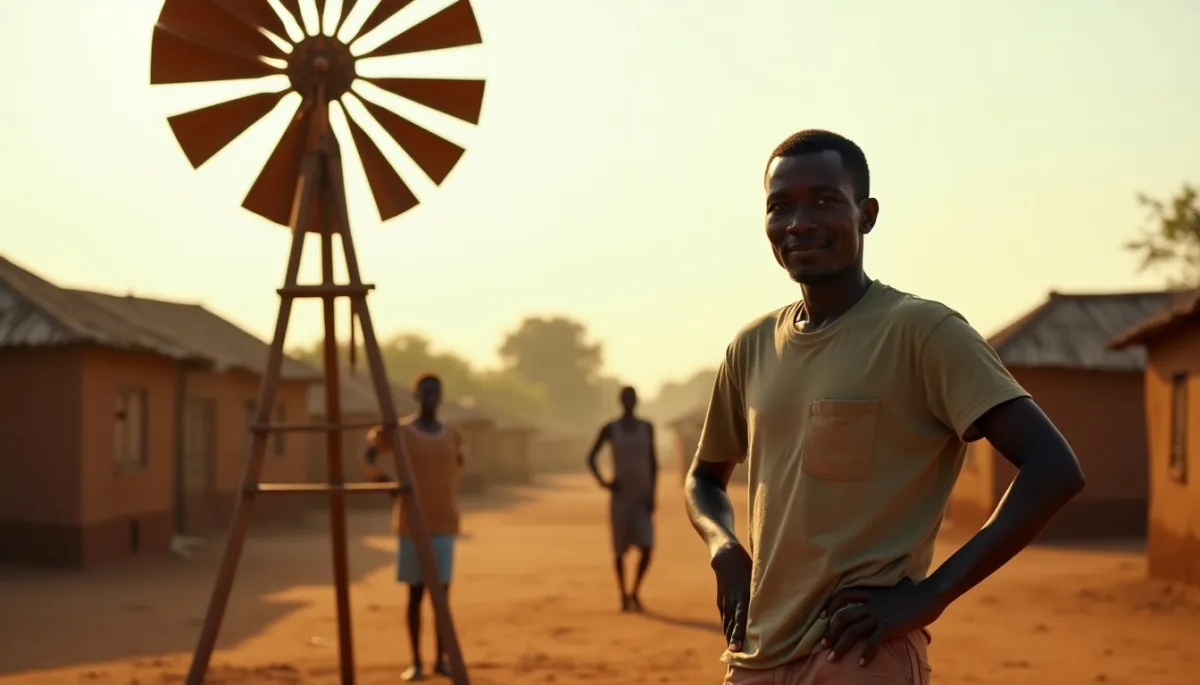
At about 14 years old, William assembled a crude but functional windmill that powered several light bulbs and charged a battery for his village. He used a bicycle frame, a tractor fan blade, shock-absorbers, and a salvaged alternator. The device lit homes and ran a radio; the sight of a lamp burning at night changed daily life.
His invention made him a local figure. Neighbors who had doubted him began to visit, children gathered to see the spinning blades, and soon aid workers and journalists came from farther away. That small generator illustrated how local ingenuity can produce immediate, measurable impact.
Livre et débrouille
The turning point came with a book. While he could not afford school fees, William spent long hours in the library of his former school. He found a slim manual about energy and windmills. Even without perfect literacy in English, he carefully studied diagrams and copied schematics into his notebook.
Learning from images and trial-and-error, he transformed drawings into reality. He scavenged the materials locally: metal from old cars, PVC, bearings, and the alternator that became the heart of the generator. He used basic tools and the help of friends and family to raise the tower that would catch the wind.
His method illustrates a lesson: technical knowledge often begins with observation, curiosity, and the willingness to experiment. The story underlines the power of informal learning and of public access to books and information.
Défis et tournants
Fame arrived after a 2007 TEDGlobal talk in Oxford, where William presented his work. The talk turned him into an international symbol of innovation from scarcity. In 2009 he co-wrote a memoir, "The Boy Who Harnessed the Wind," with journalist Bryan Mealer. The story was adapted into a 2019 film directed by Chiwetel Ejiofor, bringing his journey to an even wider audience.
Yet his path was not without contradictions. Initial attention did not erase the structural problems in Malawi: unreliable infrastructure, climate vulnerability, and limited education access remained. William himself later described how his early windmill needed improvement and how scaling such innovations requires training, funding, and supportive institutions.
To respond, William helped found the Moving Windmills Project, which focuses on education, clean water, and energy solutions for rural communities. His later work combines advocacy, practical installations, and efforts to ensure others can access the tools and knowledge he once found in a library.
What can readers take away? First, look at diagrams even if words are hard; images teach. Second, start small: a single light can transform evenings and study. Third, community projects need follow-through: a prototype is only the beginning.
William Kamkwamba's windmill is both a symbol and a blueprint. It reminds us that creativity, shared knowledge, and local action can light lives even in places forgotten by progress.
Thanks for reading, and don't forget, Enjoy Life Moments!