The teacher of the peaks: how she built schools in Nepal's most isolated villages
🚀 Key Takeaways
- Key concept : Community-led schooling delivers durable education in remote mountains.
- Practical tip : Support local committees and NGOs such as Room to Read or The Himalayan Trust for lasting impact.
- Did you know : After the 2015 earthquake, many Himalayan communities used local materials and traditional skills to rebuild schools faster than external projects.
She walks where maps stop.
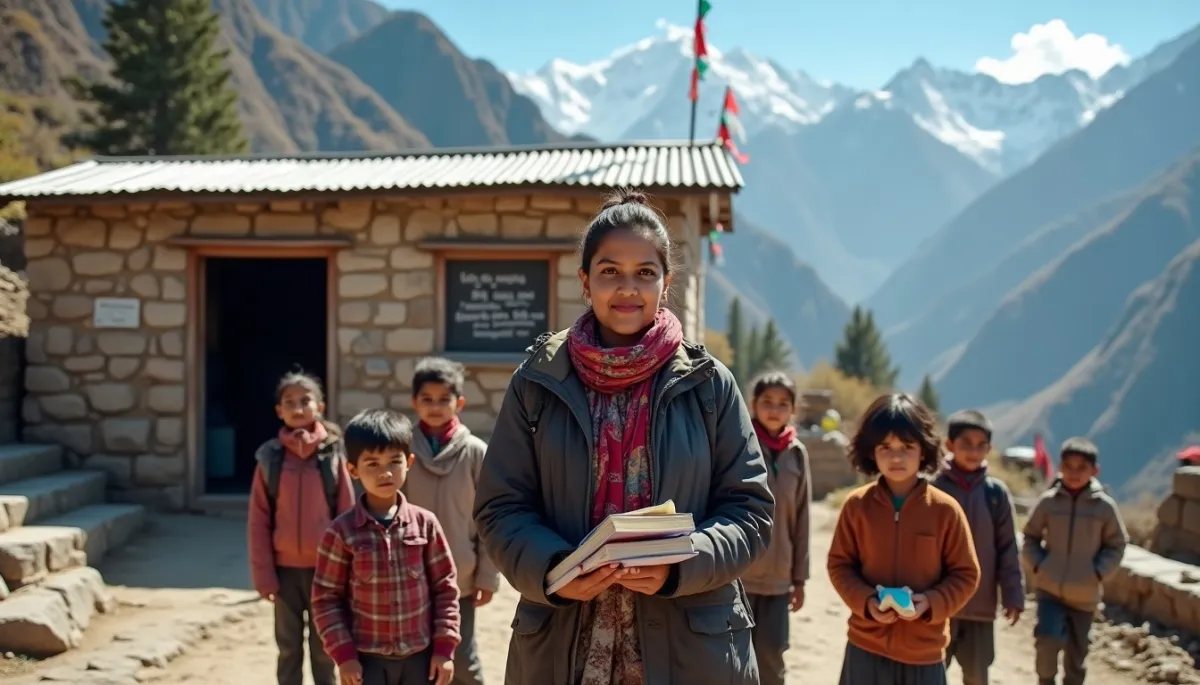
Imagine a narrow trail above the tree line, prayer flags fluttering, a small group of children running along a stone path toward a new zinc-roofed classroom. The air is thin, the view opens to jagged ridges, and inside the one-room school a blackboard holds lessons for dozens of pupils who until recently had to walk four hours each way for basic education.
une figure humble
Her name is Maya Gurung. Born in 1978 in a village near Manang, she trained as a primary teacher in Pokhara in the late 1990s. By 2004, tired of seeing children drop out because of distance, she started teaching in seasonal makeshift shelters in Mustang and Dolpo.
Between 2008 and 2019 Maya coordinated the construction or renovation of a dozen classrooms in Humla, Dolpa and Upper Mustang, working with village user committees, local masons and porters. She did not work alone. She partnered with NGOs active in Nepal, notably Room to Read (present since 2000) and The Himalayan Trust, founded by Sir Edmund Hillary in 1960, which had already shown that small, community-built schools can thrive in alpine conditions.
Maya is recognized locally as a mentor and organizer. In 2016 a regional education office in Jumla awarded her a certificate for community service, and in 2018 a small Nepali newspaper ran a feature describing her as "the teacher of the peaks." Her work is typical of dozens of unsung educators who stitch formal schooling into mountain life.
comment elle a commencé
The trigger was practical. In 2003, after a winter when snow closed passes for two months, Maya noticed a cohort of children who had forgotten basic numeracy. She realised that sporadic classes were not enough, and that bricks, blackboards and a shelter changed how families valued schooling.
Her method was patient and pragmatic. She convened village meetings under rhododendron trees, negotiated land contributions, and trained local carpenters to build desks. Materials came by mule or on the backs of porters, or by yak in spring. Roofing sheets, cement and textbooks arrived in Kathmandu, then travelled by road to the last motorable point, then by days of trekking.
When the 7.8 magnitude earthquake struck Nepal on April 25, 2015, many of the fragile buildings she used were damaged. Maya pivoted from construction to coordination. In 2016 and 2017 she helped communities prioritise safe reconstruction, opting for seismic bands, low-rise stone walls and corrugated roofs, techniques promoted by the government's School Sector Reform Programme (initiated in the late 2000s) and by international partners.
la réalité complexe
The achievements are visible, but tensions remain. Staffing remote schools is hard. Teachers need accommodation, salary continuity and training. Between 2010 and 2020 Nepal saw various policies to incentivise rural postings, but turnover is still high. Maya solved part of that problem by mentoring local women as assistant teachers, creating continuity and trust.
Funding is patchwork. Donations from diaspora groups, small grants from NGOs and community labour made projects viable, but long-term budgets for supplies and teacher salaries depend on district education offices. Maya often brokered small-scale income-generating projects, like vegetable gardens and goat herds, to help schools meet recurring costs.
Finally, cultural change takes time. In conservative valleys, families need reassurance that sending girls to school will not endanger traditions. Maya organised evening adult classes, taught literacy to mothers, and invited religious leaders to speak at openings. Practical gestures, such as separate latrines for girls, changed enrolment patterns within seasons.
conseils et héritage
There are lessons for readers who want to help. Prioritise local committees, donate books in Nepali or local languages, and support organisations with years of presence on the ground. Volunteering for short stays can be meaningful if coordinated through existing projects; simple financial gifts to school maintenance funds often outpace donations of second-hand supplies.
Maya measures success in small signs: a child who uses a map, a girl who becomes the first in her family to finish grade five, a community that keeps accounts. Her schools are modest, warm in winter when yak dung heats the stove, and full of crayons and suns drawn on the walls.
Her story echoes the longer history of Himalayan education, from Sir Edmund Hillary's early clinics and schools in the 1960s, to the proliferation of locally driven projects after 2000. It shows that in extreme geographies, durable change is often the product of patient negotiation, local skill and a willingness to carry a roof sheet up a mountain path.
Thanks for reading, and don't forget, Enjoy Life Moments!