Roberto Baggio: the quest for inner peace and the saving Buddhism of “Divine Codino”
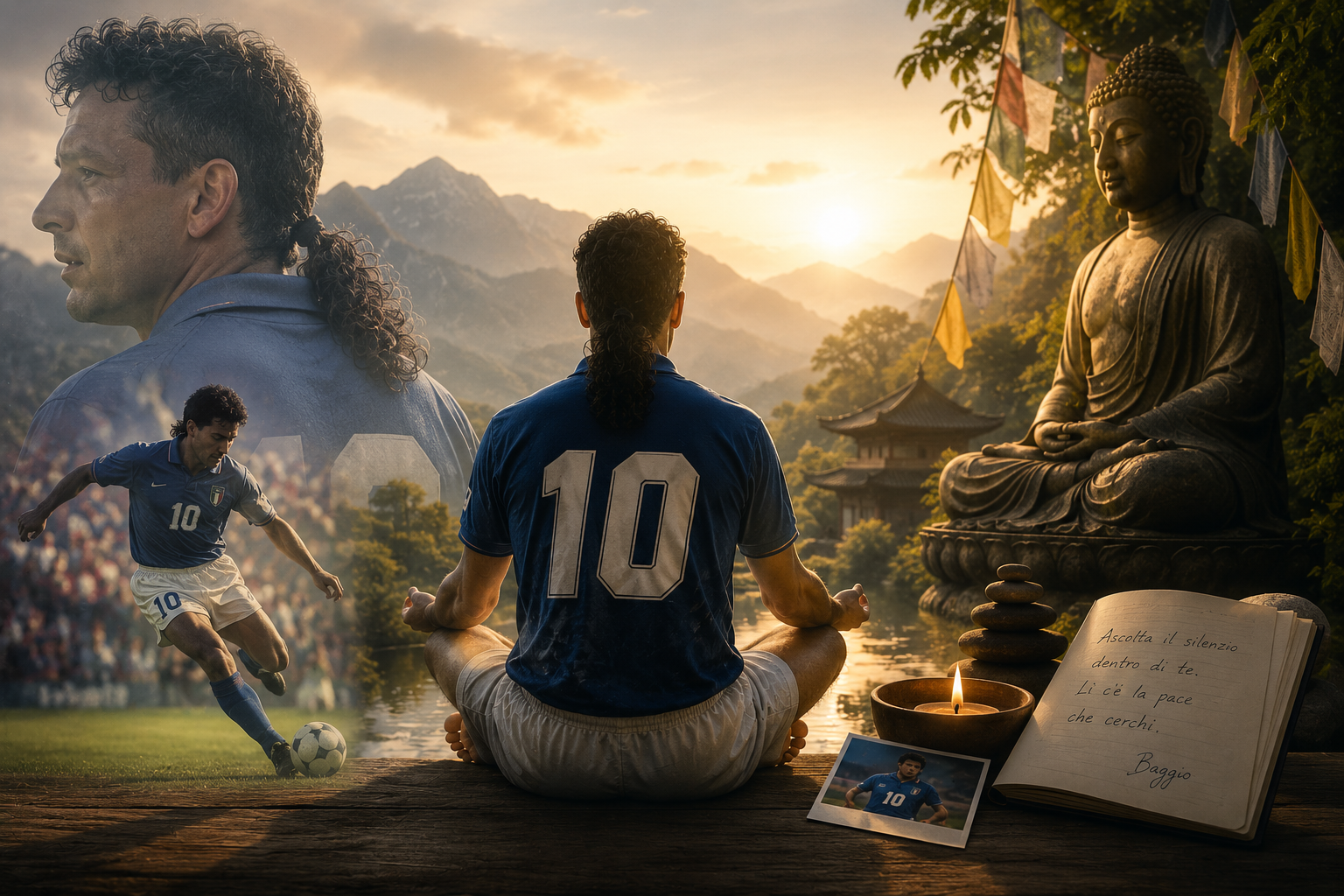
Roberto Baggio is not just a football legend. He is a man who sought calm away from the spotlight and who, thanks to Buddhism, learned to forgive himself.
🚀 The essentials
- Key concept: Baggio mixed spiritual practice and career to find balance.
- Practical advice: Integrating a short daily ritual helps get through failure.
- Did you know: Born on February 18, 1967, he won the Ballon d'Or in 1993 and has the nickname "Divin Codino".
He seems, in silence, to listen to life. Imagine him on a quiet street in Brescia, the codino at sunset, his hands in his pockets.
This image is decisive. Far from the San Siro or a full Stadio Olimpico, we perceive the break that transformed it. The man who, on July 17, 1994, missed a penalty in a World Cup final, was also looking for inner peace. On this sidewalk, the footballer and the man meet.
The public face
Roberto Baggio is a world football figure. Born in Caldogno, in the province of Vicenza, he was launched by the Vicenza center then made his name at Fiorentina between 1985 and 1990.
He joined Juventus in 1990 and received the Ballon d'Or in 1993, a rare award for a playmaker. His technique, his free kicks and his elegant style left their mark on a generation of supporters. The codino, its ponytail, has become a distinctive sign and an affectionate symbol.
In selection, Baggio has 56 caps and 27 goals. At the 1994 World Cup in the United States, he scored five goals and led Italy to the final, a performance that remains at the heart of his legend.
The inner road
Under the spotlight, there were also injuries. His knees often betrayed him during the 1990s, leading to several operations and difficult seasons. These physical constraints were coupled with intense media pressure.
The major emotional moment was the final on July 17, 1994. The missed shot on the pitch in Pasadena crystallized collective despair. For Baggio, it was an intimate and public shift. He had to learn to live with this failure that had become an image.
Over time, he turned to Buddhism, particularly the Nichiren movement and the Soka Gakkai movement. He explained that practicing the Nam-myoho-renge-kyo mantra and living in community gave him a framework to work on acceptance and resilience.
Doubts and rebirths
Adopting a spiritual practice did not mean abandoning the game. On the contrary, it accompanied a sporting renaissance. After spells at AC Milan and Bologna, Baggio joined Brescia in 2000, where under coach Carlo Mazzone he found lasting form and extended his career until 2004.
In Brescia, he rubbed shoulders with young talents, among them Andrea Pirlo at the beginning of his career, and embodies leadership based on calm and technical intelligence. His comeback illustrates how inner work can translate into more stable performance.
Yet the contradiction persists. The image of the missed penalty still haunts him in the collective memory, while in private he speaks of forgiveness and daily discipline. This tension between myth and human fragility is the strength of his story.
If you want to be inspired by his journey, start small. Five minutes of conscious breathing in the morning, a short, repeated ritual, or exploring mindfulness can help process failure. If the spiritual path appeals to you, learn about Nichiren and Soka Gakkai from reliable sources, and compare with secular approaches to meditation.
Baggio's journey reminds us that we can reconcile sporting glory and inner peace. The legend of the "Divine Codino" remains alive, not only for his technical gestures, but for the man who learned to listen to silence as much as to applause.
Thanks for reading, and remember, Enjoy life's moments!