Olfactory aromatherapy: 5 essential oils that soothe anxiety
🚀 Key Takeaways
- Core concept : Smell influences emotion through the limbic system.
- Practical tip : Use 1-2 drops in a personal inhaler or a diffuser session of 10-20 minutes.
- Did you know : The term aromatherapy was coined by René-Maurice Gattefossé in 1937, after a 1910 incident involving lavender oil.
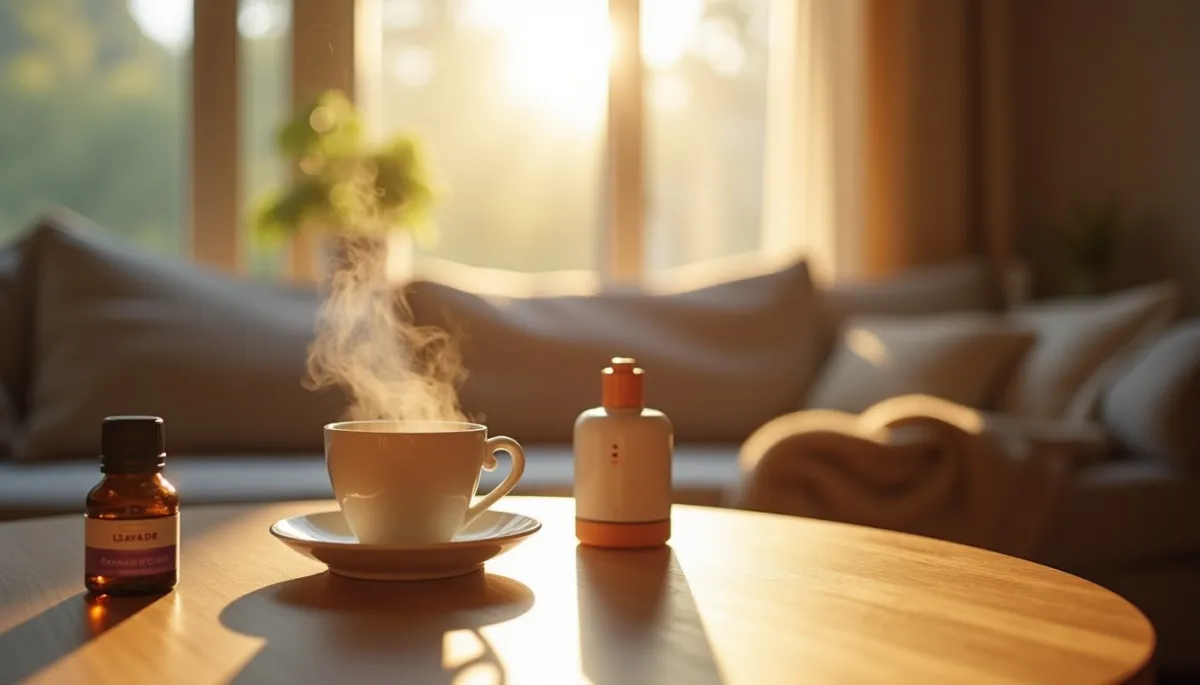
Close your eyes and breathe in. You are in a small living room, late afternoon, a diffuser humming soft lavender, a cup of tea cooling on the table.
Quiet evidence
Anxiety affects hundreds of millions worldwide, and simple rituals that rely on scent are increasingly adopted at home, in clinics, and in wellness spaces. Olfactory aromatherapy uses inhalation to deliver volatile molecules that reach the olfactory epithelium, then connect directly to emotional centers of the brain, such as the amygdala and hippocampus.
Clinical studies are growing. For example, randomized trials have shown that lavender oil inhalation can reduce preoperative anxiety and dental anxiety, while bergamot and chamomile have been evaluated in hospital and workplace settings. These studies, taken together, suggest that aroma can be an adjunct, not a cure, for anxiety.
Practical application has also spread. In Tokyo hotels since the 2010s, calming scents are used in lobbies. Corporate wellness programs in London and New York now include short aromatherapy breaks. The appeal is immediate: scent is fast, portable, and requires little effort.
Why scent matters
Smell is one of the oldest senses. The olfactory bulb sends signals to the limbic system, a brain network responsible for memory and emotion. That direct wiring explains why a scent can trigger a memory or calm an anxious pulse in seconds.
Essential oils are complex mixtures of molecules, such as monoterpenes and esters, which interact with olfactory receptors and can modulate neurotransmitter systems indirectly. This is why lavender often feels soothing, and why citrus notes can sometimes feel uplifting.
Terminology helps. A chemotype describes the dominant chemical profile of a plant species. For example, lavender labelled 'Lavandula angustifolia' is preferred for relaxation, because its chemotype is richer in linalool and linalyl acetate, compounds associated with calming effects.
Nuances and limits
Despite encouraging data, aromatherapy is not universally proven as a standalone treatment for clinical anxiety disorders. Research quality varies, and placebo effects play a role. The scent of care itself, and the ritual of self-attention, contribute to measurable benefits.
Safety is essential. Bergamot can be phototoxic unless specified 'bergapten-free', and some oils are contraindicated during pregnancy or for people with epilepsy. Children require lower dilutions. Always choose reputable brands, check botanical names, and consult a clinician for serious anxiety.
Integration is the future. Combining brief inhalation rituals with breathing techniques, cognitive tools, or therapy sessions multiplies benefits. Scents can prompt grounding moments, and repeated use can form a conditioned response, where the aroma becomes a cue for calm.
Five oils as a balm
Lavender (Lavandula angustifolia), classic and well-studied, is versatile. Use in a diffuser or 1 drop on a tissue for inhalation. Ideal for evening calm and pre-sleep routines.
Bergamot (Citrus bergamia), bright but soothing, works in short inhalations. Prefer bergapten-free oil for skin contact. In studies, bergamot has reduced anxiety markers in healthcare environments.
Frankincense (Boswellia carterii), resinous and rooting, is valued for contemplative rituals. Three drops in a personal inhaler can help during stressful meetings, its warm profile supporting a sense of focus.
Ylang-ylang (Cananga odorata) brings a floral, calming aroma. Use sparingly, it is intense. It can lower heart rate in short sessions, useful for acute anxiety spikes.
Roman chamomile (Chamaemelum nobile) is gentle, often used for children or sensitive people. A 1% topical dilution or inhalation can support relaxation during bedtime routines.
Practical recipes
Personal inhaler: place 3-4 drops of a chosen oil on the cotton wick, inhale for 3-5 deep breaths when anxiety appears. Replace wick every 2-3 weeks.
Diffuser session: 10-20 minutes, 2-4 drops total, in a well-ventilated room. Short sessions avoid olfactory fatigue and maintain effectiveness.
Topical soothe: dilute at 1% for elderly and children, 2% for most adults, in a carrier oil (sweet almond, jojoba). Apply to wrists or chest, avoid eyes and mucous membranes.
By choosing quality oils, understanding basic safety, and pairing scent with small rituals, olfactory aromatherapy can be a gentle, immediate balm for everyday anxiety. It is a practice of attention, as much as chemistry, and it invites us to breathe, notice, and ground.
Thanks for reading, and don't forget, Enjoy Life Moments!