Moonlight and the Léman: myths and realities of the lake's soft tides
🚀 Key Takeaways
- Key concept : Lunar gravity creates tiny tidal signals in Lake Geneva, while winds produce larger, rapid oscillations called seiches.
- Practical tip : Walk the promenades at dawn or after strong winds to witness seiches; consult local lake level gauges for safety.
- Did you know : The Léman covers about 582 km² and reaches roughly 310 m at its deepest point, shared by Switzerland and France.
Soft light, slight ripple, the lake breathes under the Moon.
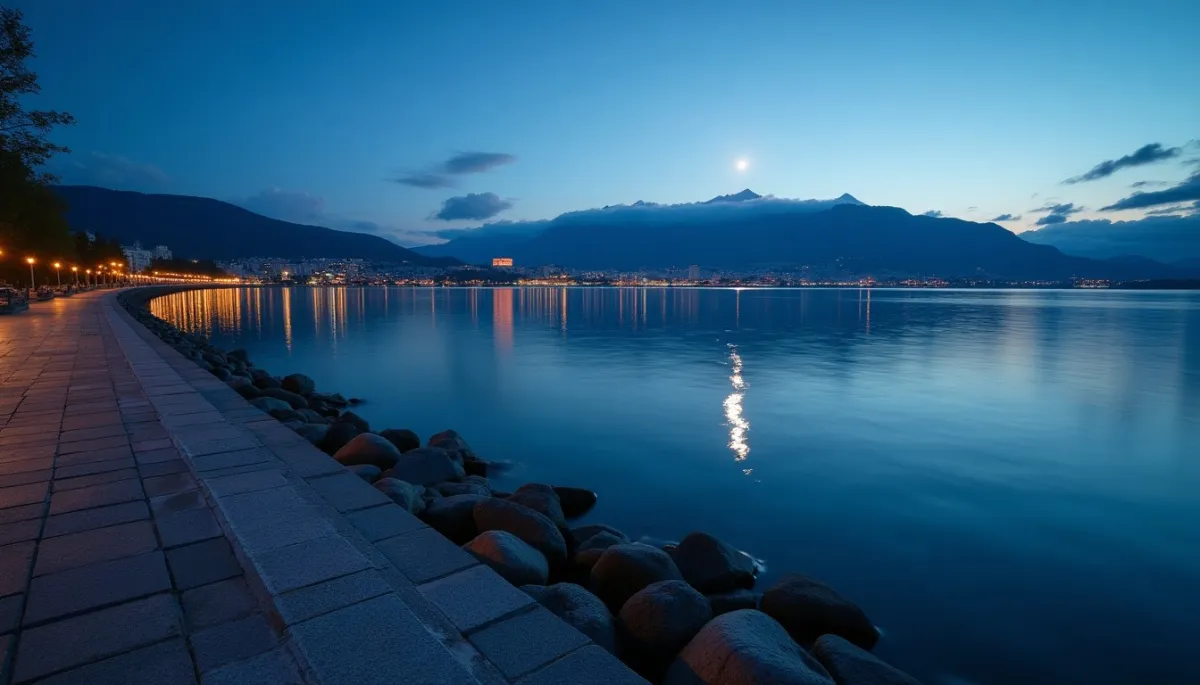
Imagine standing on the Quai d'Ouchy in Lausanne at night. The water laps gently at the quay, lights from Montreux and Geneva shimmer, and the Moon hangs low over the Alps. Locals will tell you that the lake 'follows the Moon'. It is an image that mixes science, memory and a pinch of romance.
subtile présence
What we actually feel at the shore is a mixture of effects. The Moon's gravitational pull generates a tidal forcing everywhere on Earth, and inland lakes like the Léman are not exempt. However, the amplitude of this direct lunar tide in Lake Geneva is tiny, typically measured in millimetres to a few centimetres. These micro-tides are real, but they are overwhelmed most of the time by meteorological influences.
In contrast, seiches are the dramatic actors on the Léman stage. A seiche is a standing wave in a closed or semi-enclosed basin. For Lake Geneva the fundamental seiche period is roughly 73 minutes, meaning the lake can slosh from one shore to the other in a little over an hour. This is why, after strong winds from the Jura or the Alps, you can observe oscillations that raise the water by tens of centimetres, and sometimes more, at specific points along the shore.
These phenomena are documented by Swiss hydrological services. The lake covers about 582 square kilometres and reaches roughly 310 metres at its deepest point. Continuous gauges, some with records stretching back decades, allow scientists to separate the tiny harmonic components caused by the Moon from wind-driven variations and atmospheric pressure changes.
forces mêlées
Why does the Moon matter at all for an inland lake? Gravity acts everywhere, and the same tidal constituents that shape ocean tides also induce tiny periodic signals in lakes. Modern analysis uses Fourier transforms and harmonic decomposition to isolate those constituents, such as the principal lunar semidiurnal component. On Lake Geneva, that component is measurable, particularly when the weather is calm and instrumentation is precise.
But then come the winds. The local 'bise', a cold northeastern wind, and other storm systems can pile water against one shore, creating a setup that looks nothing like a lunar tide. When the wind suddenly shifts or ceases, the lake can respond with a seiche. These oscillations are often amplified in narrow bays and harbours. Geneva's harbour and the Petit-Lac area near Nyon are known to show pronounced swings.
Fishermen, sailors and harbourmasters learned to live with this mixed forcing. Historically, before precise gauges, many communities attributed sudden rises and falls to the Moon's phases, because human perception seeks simple cycles. Today, scientists explain the coexistence of micro-tides and meteorological variability, which together create the 'marées douces' locals talk about.
mythes et réalités
Cultural memory is rich. Stories persist that fish bite better under a full Moon, or that certain quay steps become submerged 'when the Moon is heavy'. Some of these beliefs have a kernel of truth: nocturnal illumination affects fish behaviour, and human activities are synchronized with lunar cycles. Still, equating these observations with ocean-like tides is an exaggeration.
Practical consequences matter. For instance, small harbours and moorings can experience rapid changes during seiches, which may surprise swimmers and boaters. Authorities post warnings during storms, and local clubs teach how to account for oscillations when tying boats. If you plan a lakeside picnic or a swim, checking the Swiss lake level service and weather forecast reduces surprises.
For curious visitors, there is pleasure in watching both science and tradition mingle. Attend a local harbour event in Geneva, Lausanne or Montreux, talk to an old fisherman, then check the gauge data online. You will see how the Moon's gentle tug is recorded as a precise line, while the lake's mood swings under wind and pressure are visible to the eye.
Thanks for reading, and don't forget, Enjoy Life Moments!