Bioluminescence in Holbox: Magic or science?
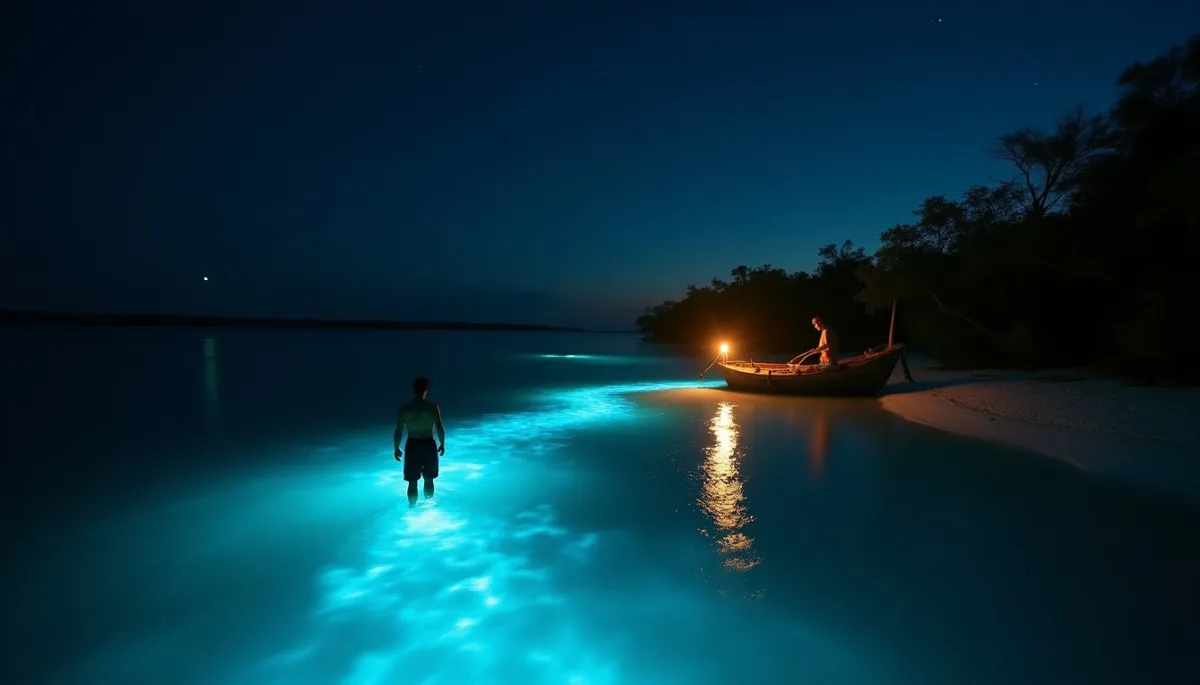
Imagine standing at the waterline of Isla Holbox, barefoot on powdery sand, while the sea beneath your feet begins to pulse. Tiny flashes trail each step, like a startled constellation. Boats drift silently, their wakes drawn in luminous threads, and the distant hum of nocturnal birds frames the scene. That first instant feels like a private trick of nature, intimate and impossible.
But that spectacle is not magic in the supernatural sense, it is the visible consequence of living organisms responding to agitation. Locals, guides and scientists have witnessed these nights for decades, and each sighting is now part of a conversation about tourism, ecology and climate. Below we examine what visitors experience, why it happens, and why Holbox’s glow both fascinates and worries those who know the island best.
Nuits de juillet, traînées d'argent : conséquences visibles sur les visiteurs et la communauté
For tourists, a bioluminescent night on Holbox is a highlight. Small, community-run night tours depart after dark from the main dock, taking passengers to shallow bays such as Punta Cocos and mangrove fringes where the effect is strongest. Social-media posts and reels, often filmed with smartphones, have multiplied in recent years, turning private wonder into a bucket-list attraction.
Locally, the phenomenon brings income. Pescadores reconvertis en guías (fishermen turned guides) tell of families able to supplement incomes during low season thanks to night tours. Restaurants and small hotels see an uptick in bookings on moonless nights, and the island’s profile as a low-impact, nature-based destination has grown.
However, there are immediate practical consequences. Boat traffic increases at night, lights are sometimes left on, and unregulated swimming with lotions or sunscreens can change water chemistry. The glow itself is fragile; repeated disturbance or pollution can dampen the plankton’s response. Observers on Holbox report nights when the light is brilliant, and other nights when it is virtually absent, a variability that affects both visitor expectations and local income.
Marées de mai, le pourquoi du phénomène : la science expliquée simplement
Bioluminescence is produced by living organisms. On Holbox, the light typically comes from microscopic plankton, mainly certain dinoflagellates. These single-celled organisms emit light when mechanically disturbed, a defensive reaction triggered by enzymes and chemical compounds commonly summarized as luciferin (the light-emitting molecule) and luciferase (the enzyme).
When waves, a passing fish, or a boat’s wake agitate the water, a chemical reaction inside the plankton releases photons. The result is a cold, blue-green glow, efficient and fleeting. This is different from harmful algal blooms sometimes called "red tides". Not all blooms are toxic; bioluminescent events are not necessarily dangerous, but they are symptomatic of changes in nutrient levels and water conditions.
Seasonality matters. The clearest displays on Holbox most often occur in the warm months, roughly June through September, when calm seas and higher water temperatures favor plankton growth. Moon phase plays a role too; new-moon nights make the glow appear brighter. Scientists from regional universities (including teams based in Yucatán and Quintana Roo) monitor occurrences to better understand links with rainfall, currents, and human activity.
Aurores d'octobre, éclaircies et ombres : contradictions et enjeux pour l'avenir
The same popularity that rewards local communities can strain the ecosystem. More visitors mean more boats and more potential pollution. Light pollution from beachfront hotels and lamps can diminish the visible effect. Sunscreen and chemical runoff alter water composition. Those are tangible risks that local NGOs and some guides on Holbox are already trying to manage.
There is also a scientific opportunity. Systematic monitoring creates baseline data that help distinguish natural variability from anthropogenic impact. Collaborations between local cooperatives and marine biologists have led to simple best-practice rules: use red or dim lights, avoid heavy boat traffic in sensitive bays, and prohibit use of chemical products before entering the water at night.
Looking ahead, management will need balance. Policies could include permits for night tours, capped group sizes, and education campaigns for visitors. If handled with respect, Holbox’s bioluminescence can remain a source of wonder and income. If ignored, the spectacle risks being dimmed by the very attention it attracts.
Practical tips: choose a certified local guide, prefer kayaks or small electric skiffs to reduce wake, go on moonless nights between June and September, and avoid lotions before entering the water. A last, quiet piece of local lore: older fishermen say the light was once so regular it guided night-time navigation; today it sometimes feels like a fragile invitation to coexist thoughtfully with the sea.
Thanks for reading, and don't forget, Enjoy Life Moments!