Belle Époque architecture: the 19th-century billionaires' taste for excess
🚀 Key Takeaways
- Key concept : Belle Époque architecture fused historicism and modern comforts to display private power.
- Practical tip : Visit Villa Kérylos and Villa Ephrussi de Rothschild early morning to avoid crowds and feel the era.
- Did you know : Many Riviera villas were designed by international architects, notably the Danish Hans-Georg Tersling.
Light, opulence, audacity.
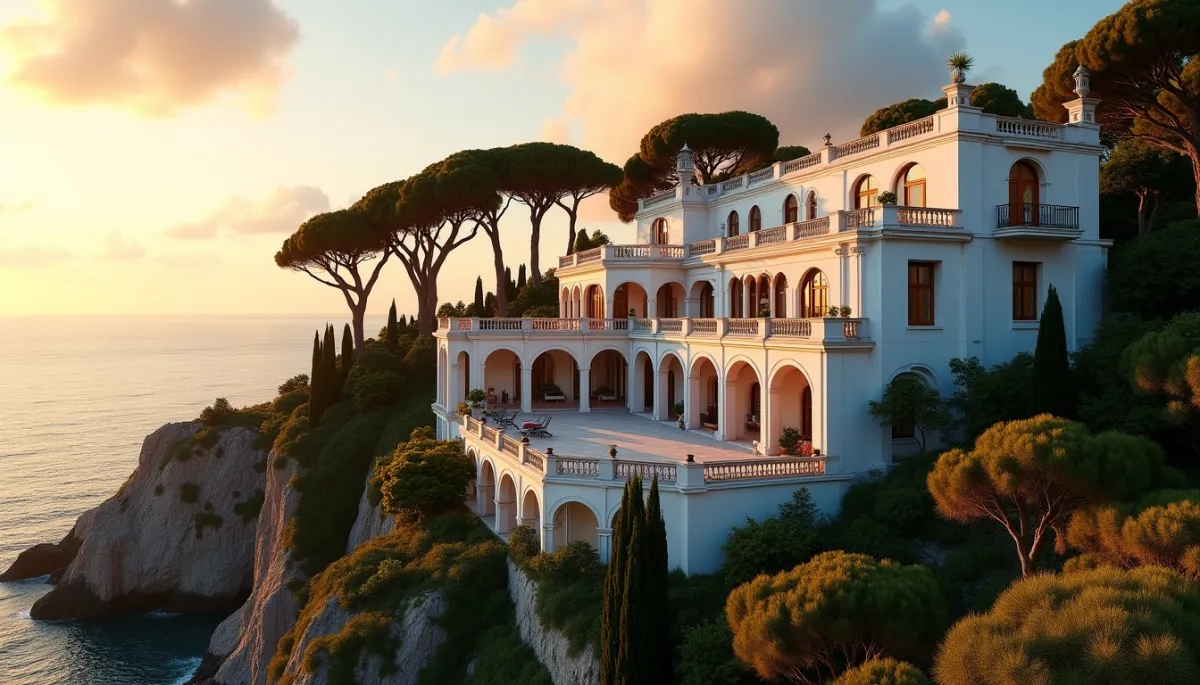
Imagine walking along a palm-lined avenue on Cap Ferrat. To your right, a white villa rises like a ship anchored to the rock, its loggias and terraces framing a Mediterranean garden where fountains whisper. A carriage or an automobile from the early 1900s could have turned the corner at any moment. That is the Riviera of the Belle Époque: a coastline staged by money and imagination.
Palaces en miniature
From Nice to Cannes, the shoreline filled with villas that look like palaces. Owners wanted summer residences that rivalled European courts, and they got them. The Musée Masséna in Nice (built 1898-1904) and the Villa Ephrussi de Rothschild (constructed 1905-1912 on Île Saint-Jean, now Cap Ferrat) exemplify that taste for splendour.
Architects translated historic styles into private homes: Italianate loggias, Neo-Baroque facades, Byzantine mosaics. Villa Kérylos, completed in 1908 by Emmanuel Pontremoli for the archaeologist Théodore Reinach, is a deliberate reconstruction of an ancient Greek domus, down to the mosaics and furniture.
These residences were also laboratories of modern comfort. Hot water, electric lighting, central heating and even early elevators were integrated to match the appearance of antiquity or Renaissance grandeur with contemporary convenience.
Pourquoi ce grandiose
The reasons are social, technological and cultural. After 1870 European peace and industrial growth created unprecedented private fortunes. The Riviera became fashionable: winter sunlight, mild climate and a landscape that invited theatrical architecture.
Patrons such as Baroness Béatrice Ephrussi de Rothschild, Théodore Reinach, and a constellation of British, Russian and Scandinavian nobles chose this coast to show status. Hiring foreign architects like Hans-Georg Tersling (a Dane who shaped many Riviera façades) testified to an international taste and to networks of influence spreading across Europe.
World fairs and archaeological discoveries fed a hunger for styles. The 1900 Exposition Universelle in Paris revived eclectic historicism while electricity and new materials allowed larger spans and decorative freedom, so builders could mimic past glories without sacrificing modernity.
Éclat et limites
Yet the grandeur had contradictions. These villas were statements of permanence on a fragile coastline. Many required massive earthworks, retaining walls and complex drainage to hold terraces and gardens on steep sites. The cost of maintenance often exceeded the initial outlays.
History also intervened. The First World War (1914-1918) changed social orders and leisure patterns. Some villas were repurposed as hospitals or headquarters; others fell into neglect during the interwar years. After 1918, tastes shifted toward Art Deco and functionalism, though the Belle Époque legacy remained physically present.
Today, appreciation mixes awe and conservation challenges. Several villas are museums or private hotels, like parts of Cap Ferrat and the public Musée Masséna. For the visitor, the experience is both aesthetic and instructive: these buildings tell stories about wealth, technology, artistic borrowing and the making of modern tourism.
Practical advice: plan visits in shoulder seasons, join guided tours that explain architectural details, and combine house visits with garden walks to understand how interiors and exteriors were designed as a single theatrical experience.
Thanks for reading, and don't forget, Enjoy Life Moments!