Light and art festivals: when Vevey becomes an open-air gallery
🚀 Key Takeaways
- Key concept: Temporary light art makes public space visible in new ways.
- Practical tip: Dress warm, arrive after dusk and pick Quai Perdonnet for postcard views.
- Did you know: Vevey is home to Chaplin's World and the Alimentarium, cultural anchors that feed creative programmes.
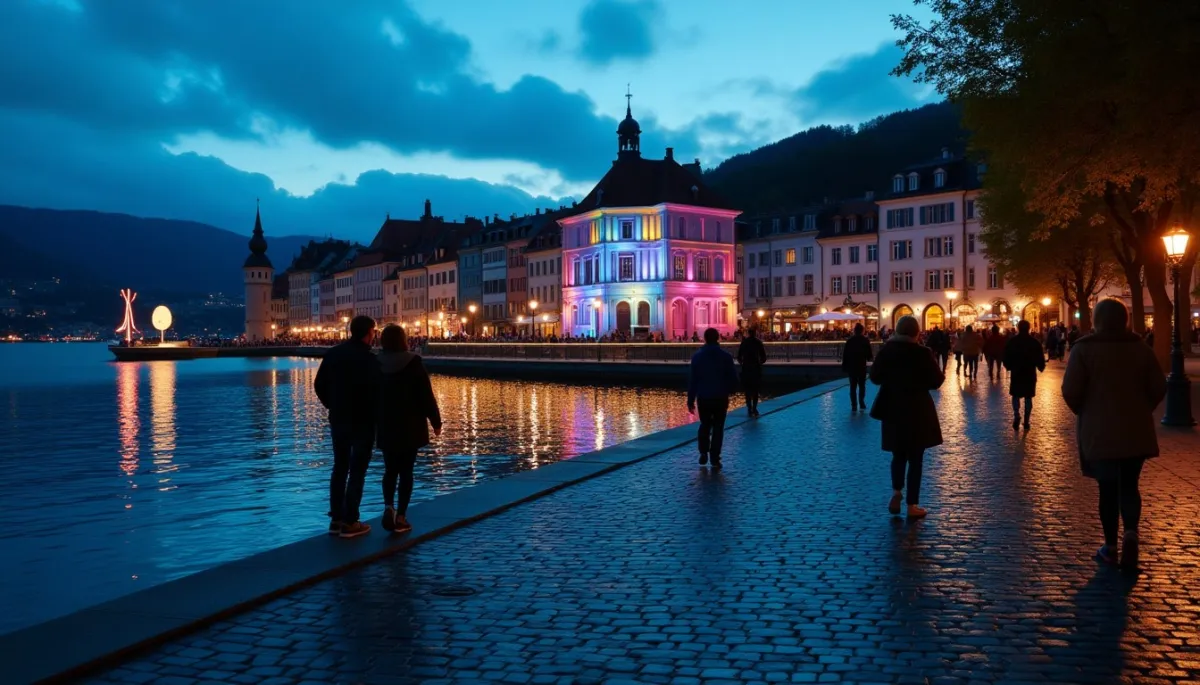
Night becomes a stage. Imagine the lake reflecting colors, a giant fork silhouette by the quay, and mapped projections sliding over classical façades.
Luminous promenades
In recent years, Vevey has embraced ephemeral light as a way to animate its historic centre. Installations range from small interactive lanterns tucked in an alley, to large-scale projection mapping on municipal buildings, to sculptures that glow along the promenade.
These events are often scheduled from late autumn through winter, when nights are long and the lakefront acts like a natural mirror. Nearby Montreux and Lausanne have similar moments, but Vevey's mix of museums, market squares and intimate streets gives each artwork a distinctive frame.
Technically, much of what you see is projection mapping (a technique that projects images onto three-dimensional surfaces, so the picture fits windows, cornices and statues). Other pieces use LED, fiber optics or low-energy bulbs to minimize impact while maximizing visual effect.
Why Vevey shines
Location matters. Vevey sits on the edge of the UNESCO-listed Lavaux terraces (inscribed in 2007), and its lakeside promenades attract visitors year-round. Cultural institutions, notably Chaplin's World (opened 2016) and the Alimentarium, help sustain a calendar of events that welcomes both local artists and international creators.
Municipal support and local initiatives have encouraged site-specific work. Small grants, partnerships with regional festivals, and cooperation with businesses along the quai allow artworks to be installed in public space. Galleries and artists also value Vevey's scale: the town is human-sized, which makes interactions between people and art immediate.
There is also a storytelling angle. Vevey's history, from market days at Place du Marché to the presence of Chaplin in the 1950s and 1960s, provides narratives that artists pick up. A projection might recall film imagery, or a light trail may lead visitors from the train station to a temporary installation at the pier.
Shadows and questions
As with any cultural trend, tensions exist. Conservationists urge care when installations are placed near historic façades or in vineyard-facing zones. Light pollution is a concern for residents and for wildlife along the lakeshore, so organisers increasingly favor softer fixtures and time-limited shows.
Funding and relevance also matter. Some events are high-profile and attract tourism, while others are small and experimental. Balancing commercial appeal with artistic risk-taking is a conversation ongoing among curators, restaurateurs and the municipal council.
Looking ahead, expect more hybrid experiences: augmented reality layers accessible by smartphone, community-led projections that invite participation, and greener technologies such as solar-powered lights. For visitors, that means more surprise encounters, but also the need to choose responsibly which shows to attend.
Practical advice: come after dusk, take the train to Vevey (easy connections from Lausanne and Geneva), enjoy a lakeside dinner before the main show, and stand near the quay or Place du Marché for the best panoramic photos. If you photograph at night, use a steady hand or a small tripod and prefer long exposures to capture the depth of colors.
Thanks for reading, and don't forget, Enjoy Life Moments!