The man who planted a forest with his own hands: the story of Jadav Payeng
🚀 Key Takeaways
- Concept key : One person can trigger large-scale afforestation over time.
- Practical tip : Start with native species, protect young trees, and involve neighbors.
- Did you know : Molai forest hosts deer, birds and even big mammals that migrated there as the trees matured.
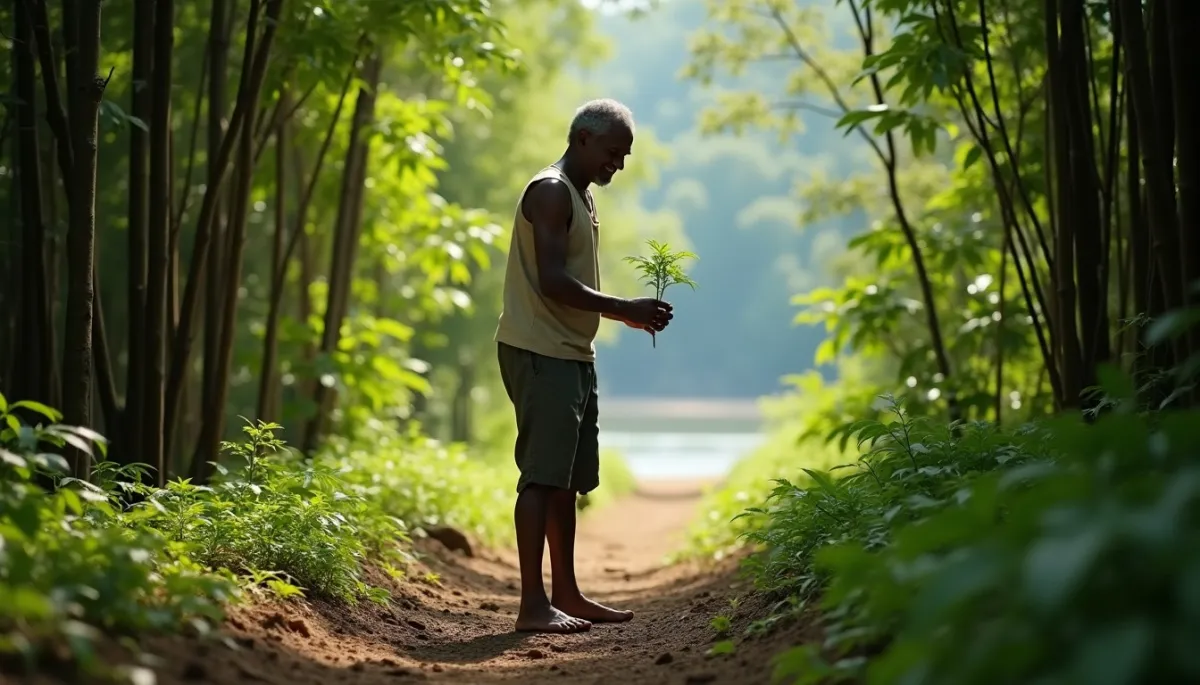
He looks small against the canopy. Imagine an older man, palms darkened by soil, standing on a shady path while sunlight filters through leaves he planted decades ago.
A forest grows
Jadav Payeng is a forester who became famous for one achievement, yet his life is woven from many small acts. For roughly four decades he planted, guarded and nurtured trees on sandbars and eroded banks of the Brahmaputra river, on and near Majuli island, Assam, India.
The woodland he is credited with creating is commonly known as Molai forest, after his local nickname. Today it covers about 1,360 acres (roughly 550 hectares), a mosaic of bamboo groves, native trees and undergrowth that now supports deer, monkeys, birds and other wildlife.
Recognition followed slowly. International attention grew with the short documentary "Forest Man" (2013), and in 2015 the Government of India awarded him the Padma Shri, one of the country's civilian honors. Those milestones helped place a solitary, persistent effort on the world map.
A patient beginning
The story began in the late 1970s, when Payeng noticed animals dying from extreme heat on a barren sandbar. Moved by that sight, he started planting bamboo and other saplings to stabilize the soil and create shade for wildlife.
His method was simple and practical. He collected and raised seedlings, carried them by hand across river channels, and guarded them from grazing cattle and floods. He adapted species selection to the local ecology, favoring hardy, native plants that could survive shifting soils and monsoon patterns.
Over the years, what started as a strip of planting expanded into contiguous forest. The growth was incremental, measured in thousands of saplings, seasons of watering and patient protection. Local villagers gradually took note, and some began to help, but much of the labor remained his alone for decades.
Roots and challenges
The achievement is inspiring, yet not without complexity. Majuli is the world’s largest river island, subject to severe soil erosion and changing river channels. A forest planted on sandbars faces continual natural threats, including seasonal floods that can wash away young trees.
Recognition brought support, but also questions about scalability and dependence on individuals. Molai forest shows that one person can jumpstart ecological recovery, yet lasting landscape restoration usually requires community stewardship, protective policy and material resources.
Climate change adds another layer. Changing monsoon intensity and river behavior mean that restoring native ecosystems now needs adaptive planning, mixed species that tolerate extremes, and long-term monitoring. Payeng’s story teaches resilience, but also underlines that heroic individuals cannot replace institutional action.
Lessons in practice
For anyone inspired to plant, there are practical takeaways from Payeng’s approach. Start with native species, which are adapted to local pests, soils and rainfall. Use pioneer species such as bamboo or fast-growing legumes to stabilize soil and create shade for slower-growing trees.
Protect young plants from grazing and fire. Simple barriers, local watch systems and planting in community clusters raise survival rates. Hydration matters, but priority goes to placement: planting in micro-catchments and along natural water lines helps seedlings survive dry spells.
Finally, think community. A single planter can create proof of concept, yet multiplying impact depends on neighbours, local institutions and policy support. Volunteer seed banks, school planting days and district afforestation programs translate individual passion into durable landscape change.
Molai forest remains a living classroom. It is a reminder that small acts, repeated with care, can transform a place and invite wildlife back. It is also a call to build systems that protect and expand such efforts, so the next forest is a shared achievement, not a solitary miracle.
Thanks for reading, and don't forget, Enjoy Life Moments!