Roberto Baggio: the quest for inner peace and the saving Buddhism of “Divine Codino”
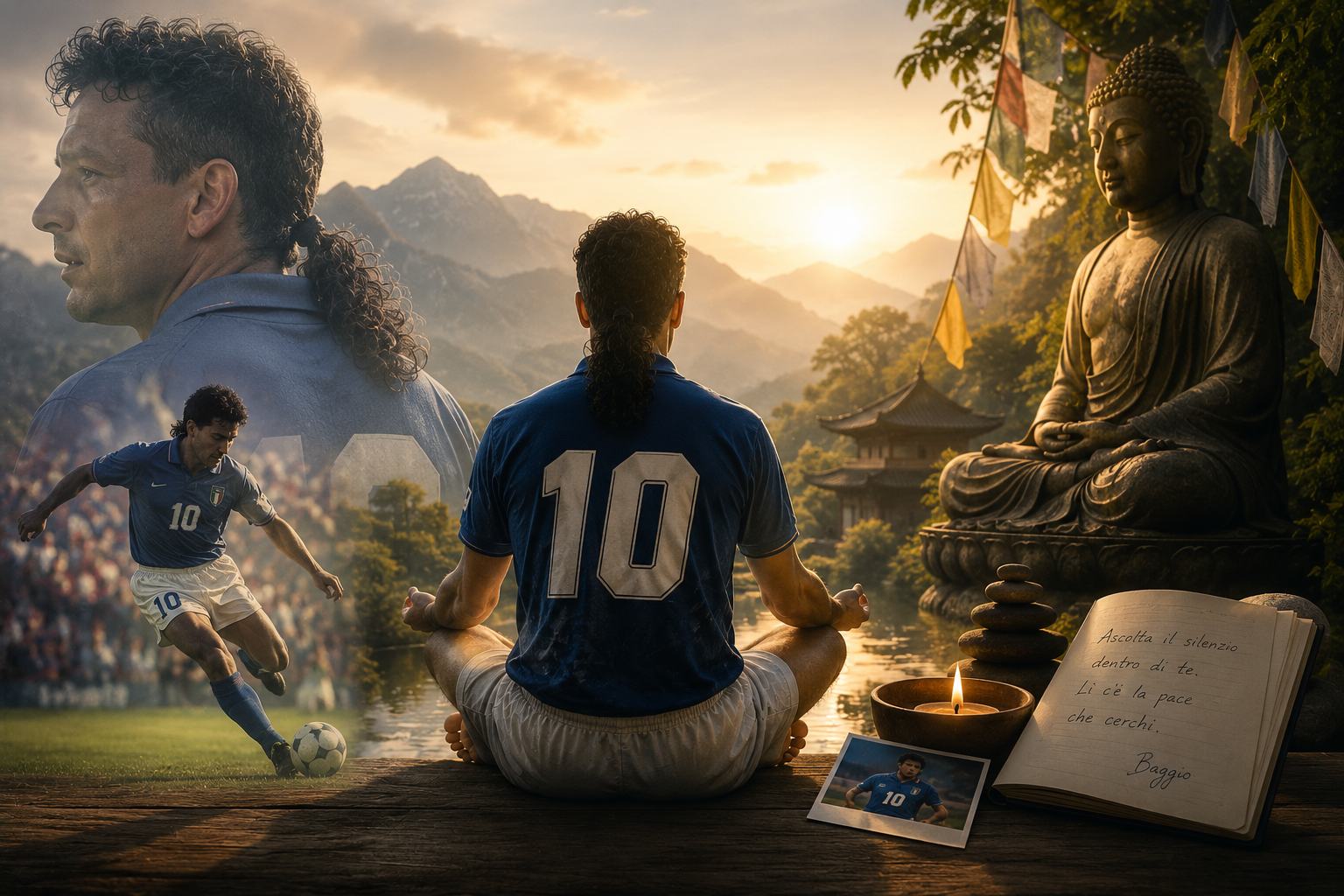
Roberto Baggio is not just a football icon, he is a story of injury, resilience and spiritual rebirth. From Italian stadiums to the silence of Buddhist practices, his life tells the story of a quest for inner peace.
🚀 The essentials
- Key concept: Baggio combined sporting genius and spiritual practice.
- Practical advice: Small daily rituals (breathing, meditation, speaking) help manage stress after a failure.
- Did you know: His famous bun earned him the nickname “Divin Codino”, which has become a sign of belonging for supporters.
He finally seems calm.
Visualize him, sitting in a garden in Brescia, bun loose, gaze fixed on the horizon; not in a locker room but in the morning light, away from 70,000 screams. The scars from the operations and the memory of the missed shot are there, but his face exudes quiet attention. This contrast between past drama and present calm structures his story.
portrait of a genius
Roberto Baggio was born on February 18, 1967 in Caldogno, in the Veneto region. Trained in Vicenza, he exploded at Fiorentina then had a series of notable stages: Juventus (1990-1995), AC Milan (1995-1997), Bologna (1997-1998), Inter (1998-2000) and finally Brescia (2000-2004), where he ended his professional career in 2004.
On the international scene, he embodies Italy. He scored decisive goals at the 1994 World Cup in the United States and took the Azzurri to the final. On July 17, 1994, in Pasadena, his missed penalty against Brazil remains an image engraved in the collective memory.
Number 10, dribbler, master of free kicks, Baggio becomes a universal figure. His play brought trophies, including European successes with Juventus in the early 1990s, and earned him the admiration of generations of supporters.
injuries and consequences
Talent did not prevent pain. Baggio suffered numerous knee injuries and several operations that threatened his sporting continuity. These periods of convalescence often isolated him, giving him time to reflect away from the lights of the stadium.
His career has also experienced conflicting episodes. The transfer from Fiorentina to Juventus in 1990 caused outrage among Viola fans, who burned jerseys. Further club changes and fluctuations in form created moments of exile and rebuilding, notably his rebirth under Carlo Mazzone at Brescia in 2000.
The summit and the abyss can be close. The missed penalty in 1994 left a long, public and intimate mark. Rather than burying him, these trials pushed him to seek moral and spiritual answers off the field.
Buddhism as an anchor
In the early 1990s, Roberto Baggio turned to Nichiren Buddhism and joined Soka Gakkai, a secular Buddhist movement. He declared on several occasions that this practice had brought him serenity and guidance for experiencing mourning, guilt and reconstruction.
Nichiren practice often includes chanting the phrase “Nam-myoho-renge-kyo” (formula aimed at activating one's life potential). For Baggio, this repetitive, communal ritual was a concrete means of grounding after moments of public shame and physical pain.
This spiritual orientation has not made him fiercely secretive. It changed his relationship with the world: he became more reserved, thoughtful and attentive to the suffering of others. His journey shows how an elite athlete can convert competitive experience into ethical and spiritual maturity.
Thanks for reading, and remember, Enjoy life's moments!