Johnstons of Elgin cashmere: two centuries of Scottish craft
🚀 Key Takeaways
- Core concept : Johnstons of Elgin is a vertically integrated Scottish mill specialising in cashmere and fine wool, with roots dating to 1797.
- Practical tip : To extend a cashmere piece's life, wash gently with wool detergent, reshape and dry flat, and store folded with natural moth deterrents.
- Did you know : Over 70% of the world's raw cashmere originates from China and Mongolia, but brands like Johnstons process and finish the fibre in Scotland for traceable quality.
Softness that tells a story.
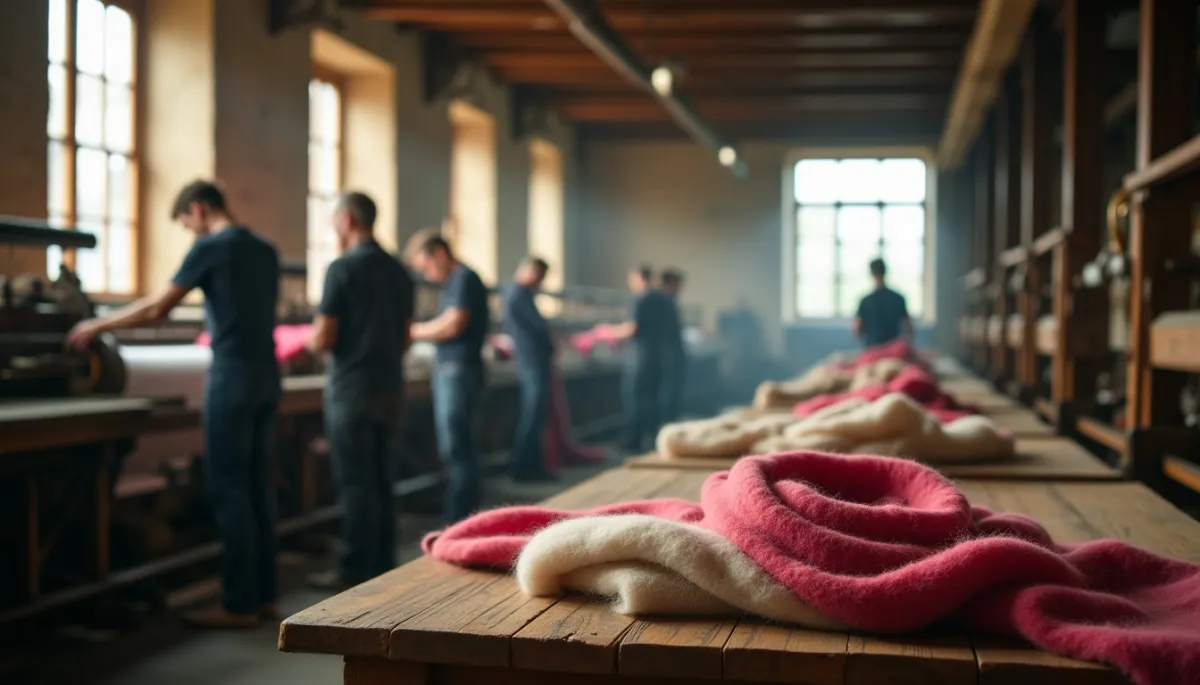
Imagine stepping into a mill on the banks of the river Lossie in Elgin, Moray, the air warm with steam and the low clack of weaving looms. Workers move between spinning frames and finishing machines, hands and eyes trained by generations, while bolts of dyed cashmere glide toward a final, careful hand finish. The scene is both industrial and intimate, a choreography of centuries-old gestures and modern precision.
La matière profonde
Johnstons of Elgin built its reputation on two principal fibres, cashmere and fine merino wool, treating raw fibre as a living material that reacts to every touch. Cashmere begins its journey thousands of miles away, in the cold plateaus where goats produce the ultra-fine undercoat. The best batches are selected for micron count, a technical measure of fineness.
Having control over the full chain, from dehairing to spinning, gives Johnstons the capacity to protect that rarity. Dehairing removes coarse guard hairs, spinning tunes yarn twist and ply, and weaving or knitting establishes the fabric's hand and drape. Each stage is a quality gate that determines whether a run becomes a long-lived scarf or a discarded lot.
For collectors of luxury knitwear, the visible signs of this craft are subtle: a tight, even stitch; a dye that sits within the fibre; edges hand-touched to avoid fraying. These are the signatures of mill work, small assurances that a piece will soften beautifully with age rather than pill or distort.
Mémoire de tissage
The mill's history is tangible in its brick and stone and in the records of adapting machinery across centuries. Founded in 1797 in Elgin, in Scotland's north-east, Johnstons survived industrial shifts by constantly re-investing in its capabilities. The brand kept processing at home when many competitors outsourced finishing to lower-cost countries.
This decision to remain vertically integrated translates into traceability. When a customer buys a Johnstons cashmere wrap, the company can describe how the fibre was treated and where the finishing occurred. In a luxury market where provenance matters, that narrative adds value beyond the yarn itself.
Johnstons has also supplied high-profile clients and institutions that expect consistency, which pushed the mill to refine standards. Their catalogue expanded from rugged Highland tweeds to delicate cashmere stoles, showing a capacity to serve both traditional outerwear and modern luxury wardrobes.
Fils d'avenir
Today the challenge is twofold: maintain artisanal excellence, and respond to ethical and environmental questions around cashmere. Global overgrazing and variable herding practices have put the industry under scrutiny, prompting mills and brands to demand greater traceability and to invest in regenerative grazing projects.
Johnstons participates in this conversation by emphasising long-term relationships with suppliers, and by improving processes that reduce water and chemical use in dyeing and finishing. The mill pairs traditional finishing techniques, such as fulling and hand-pressing, with digital monitoring to cut waste.
Yet contradictions remain. Luxury demand can push volumes, while sustainability requires restraint. The evolution will likely be hybrid: smaller, higher-value collections, more transparent supply chains, and innovation in fibre blends that keep the familiar softness while reducing environmental footprint.
For the consumer, knowledge becomes part of luxury. Ask about micron counts, finishing locations, and repair services. Choosing a Johnstons piece today is less about logo and more about supporting a craft that still happens, with care, in a Scottish mill.
Thanks for reading, and don't forget, Enjoy Life Moments!