Jane Goodall: unconditional love for nature that redefined our place in the world
🚀 Key Takeaways
- Core idea : Observations at Gombe proved chimpanzees use tools, reshaping the boundary between humans and animals.
- Practical tip : Support local conservation, join Roots & Shoots, or choose plant-based meals to reduce pressure on habitats.
- Did you know : Goodall earned her PhD from Cambridge in 1965, without an undergraduate degree, after beginning fieldwork in 1960.
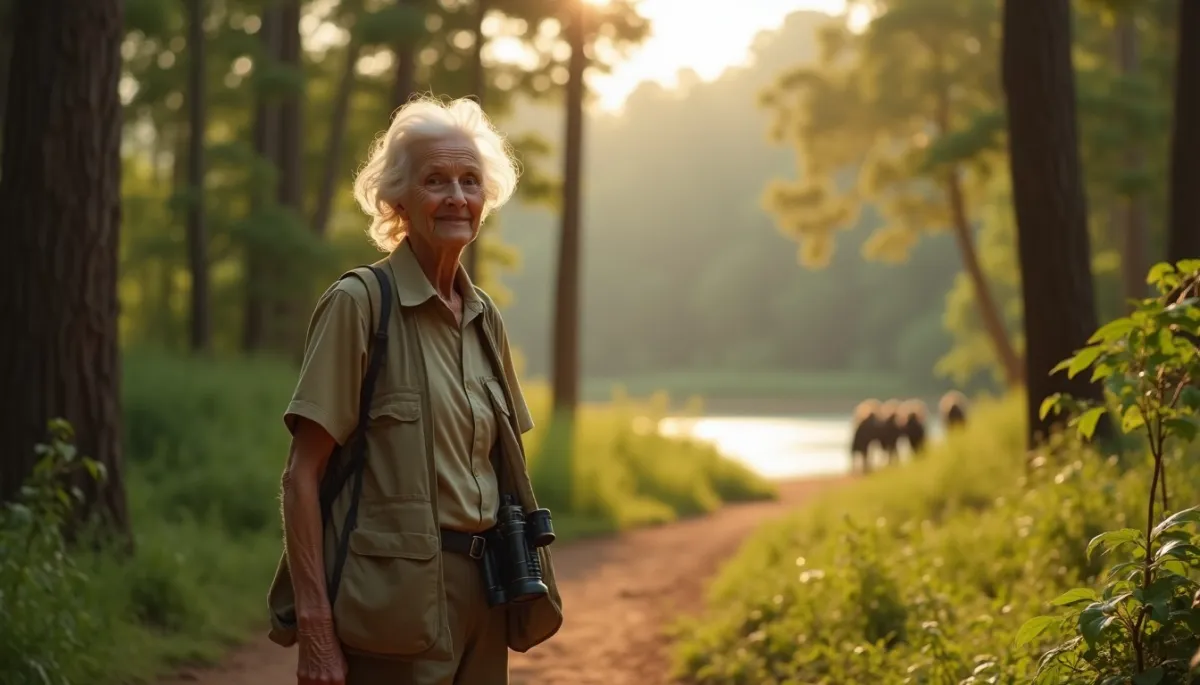
She stood very still, binoculars at her chest, listening to a chimpanzee family moving through the canopy. The heat of the Tanzanian afternoon softened into long shafts of light, and the river murmured nearby, as if the forest itself kept time with observation.
A life observed
Jane Goodall, born April 3, 1934 in London, arrived at Gombe Stream in 1960 under the invitation of paleontologist Louis Leakey. There she began systematic observation of wild chimpanzees, a practice that would overturn long-held scientific assumptions.
Her 1964 reports, and later academic work culminating in a PhD from Cambridge in 1965, documented tool use by chimpanzees. At the time, tool-making was widely considered a uniquely human trait. Naming individuals like David Greybeard, Goodall treated subjects as personalities, and that choice made both science and storytelling richer.
Her books, notably In the Shadow of Man (1971) and The Chimpanzees of Gombe (1986), translated dense field notes into vivid narratives. Recognition followed, from the establishment of the Jane Goodall Institute in 1977 to honors such as being named a UN Messenger of Peace in 2002 and receiving a damehood in 2004.
Roots of curiosity
The path that led Goodall to Tanzania began in childhood. As a young girl she loved animals, kept a toy chimpanzee, and read naturalists. She pursued her ambition despite not following a conventional university route at first.
Louis Leakey saw in her an observer with patience and empathy. He funded her first trip to East Africa in 1957 and later the Gombe work. Anecdotes from early seasons include her waiting hours for a single chimpanzee to reveal a behavior, and the moment she saw a chimp fashion a stem into a probe to fish termites out of a mound, a revelation that challenged definitions of "tool" in science.
Her method was radical: long-term immersion, careful naming of individuals, and a willingness to describe emotional lives in animals. Critics accused her of anthropomorphism, the attribution of human traits to animals, but subsequent research confirmed many of her observations.
Complex truths
Goodall's work did not romanticize nature. In the mid-1970s, she documented violent conflicts among chimpanzee communities, the so-called Gombe chimpanzee war from 1974 to 1978. Those events complicated the image of peaceful primates and taught us about the darker aspects of social life in animals.
Her conservation work responded to growing threats: habitat loss, poaching, and the illegal pet trade. In 1991 she founded Roots & Shoots, a youth program that now operates in over 60 countries, empowering young people to act on environmental, humanitarian and animal welfare issues.
Today, Goodall remains an emblem of compassionate science and practical activism. Her message is simple and urgent: empathy must guide our choices, and long-term commitment can change systems.
Acts to emulate
Visit a protected area mindfully if you travel to see chimpanzees. Gombe Stream National Park in Tanzania is best visited during the dry season, roughly June to October, when sightings are easier. Book through certified local guides and respect viewing rules to limit disease transmission.
Support conservation groups that work with local communities, such as the Jane Goodall Institute, which combines research with livelihood projects. Start or join a Roots & Shoots chapter to translate concern into action at school or in your neighborhood.
Small daily habits matter: reduce single-use plastics, favor plant-based meals a few times a week, plant native trees, and educate others. These actions lessen human pressure on wild places and honor the spirit of Goodall's life.
Thanks for reading, and don't forget, Enjoy Life Moments!