Hand-patinated shoes: the art of ageing leather like a work of art
🚀 Key Takeaways
- Core concept: Patina is the controlled ageing of leather to create depth and personality.
- Practical tip: Rotate shoes, use shoe trees and apply neutral cream sparingly to preserve patina.
- Did you know: Houses such as Berluti popularized artistic patina on Venezia leather in Paris since the late 19th century.
Beauty born of use.
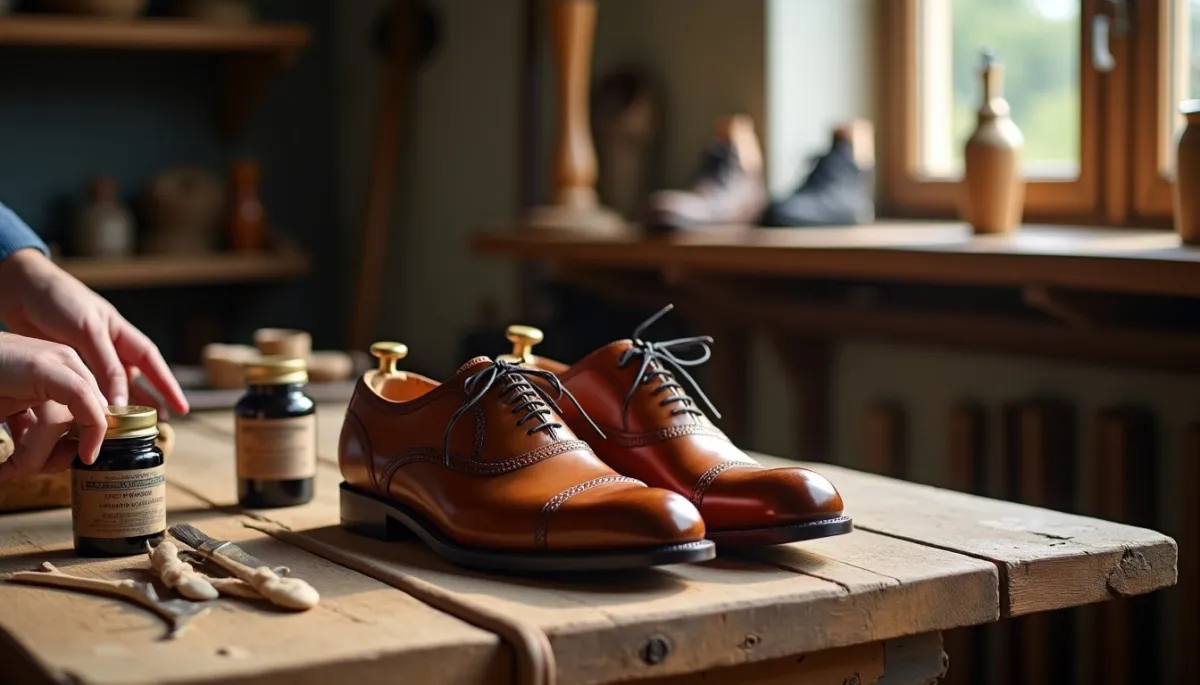
Imagine a quiet atelier in Naples or the light-filled salon of a Parisian maison, brushes, diluted aniline dyes lined up like watercolours, and a shoemaker bending over a pair of calf leather oxfords. The air smells faintly of wax and beeswax, and each stroke deposits a thin veil of colour that will be buffed, steamed, and layered until the leather sings with depth.
Patina as painting
Hand patination is a decorative and restorative technique. Craftsmen (or craftswomen) apply dyes, pigments and creams by hand to modulate colour, highlight contours and produce subtle gradients. The result is neither factory finish nor random wear, it is a deliberate aesthetic.
Ateliers such as Berluti in Paris made the patina of Venezia leather a signature. Bespoke workshops in London, for example John Lobb, and makers in Northampton like Gaziano & Girling, also offer bespoke finishing where the final shade is achieved with brushwork and patient layering.
Technically, the process uses aniline dyes (transparent, allowing the grain to show), pigments for opacity, and waxes for protection. Between layers artisans often use heat, friction and polishing to fuse the pigments to the leather, creating a depth that changes with light and time.
Racines et raisons
The resurgence of hand-patinated shoes is rooted in a broader desire for authenticity. In a world of mass production, bespoke or small-batch finishing offers a contrast: a visible human touch and imperfection that feels honest.
Historically, ‘patina’ is a word borrowed from metalwork and ceramics, meaning the surface changes accumulated with age. Applied to leather, it became a mark of refinement. In the 20th century, shoemakers refined techniques to intentionally accelerate and control those changes.
Today, sustainability conversations feed interest in patina. Buyers prefer fewer, better things that age gracefully, rather than disposable footwear. A pair of well-patinated shoes, maintained, can become more desirable with age, and even more valuable on the secondary market.
Tension créative
Yet there is a creative tension. Hand patination requires skill, and its subjectivity raises questions. How much transformation is ethical when claiming a ‘‘natural’’ patina? Some purists argue that only time should mark leather, others welcome the artisan’s intervention as part of the object's biography.
Commercial brands face another dilemma: how to scale a craft that resists scaling. Major maisons can offer limited patination services, but authentic hand-finishing remains time-consuming and costly. That is why bespoke and small ateliers continue to attract collectors who seek uniqueness.
Practically, patina also demands care. Simple rules extend its life: alternate footwear to let leather rest, keep humidity controlled, use cedar shoe trees to maintain shape, and apply colorless cream sparingly to protect without flattening depth. For repairs, seek a specialist who understands layered dye work.
In the end, owning hand-patinated shoes is a relationship. You learn the language of the leather, you notice a darkened toe or a warm halo at the heel, and these signs become part of a story. The shoe becomes an archive of journeys, dinners, trains and long walks that no factory finish can mimic.
Thanks for reading, and don't forget, Enjoy Life Moments!